

By Alenka Krašovec (University of Ljubljana) and Tim Haughton (University of Birmingham)
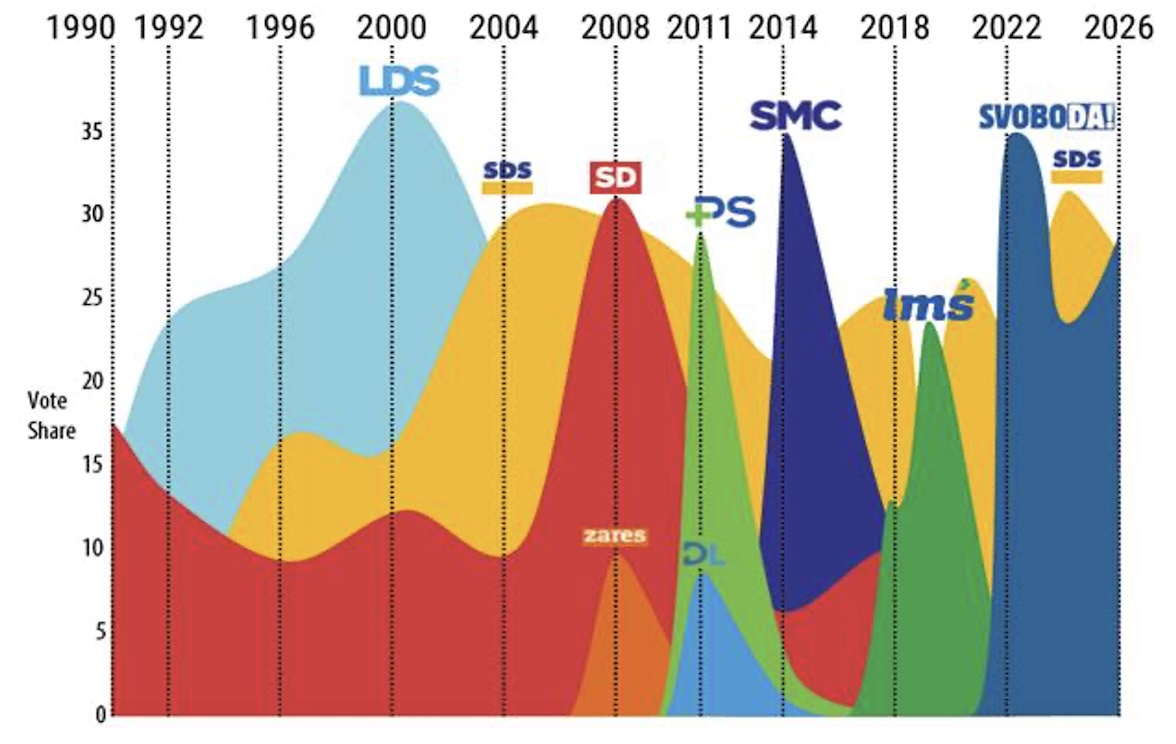
This time it was different. For almost two decades Slovenia has provided plenty of material for scholars of new political parties. The country’s elections always seemed to follow a familiar script. A new party formed a few weeks or months before an election attracts a large slice of the vote, but by the time of the subsequent election support for that new party experienced steep drops in support with many of those votes captured by a newer party in what we have dubbed a new party subsystem.
But Freedom Movement, the winner of the elections in 2022, came out on top again in 2026 with 28.6% of the votes meaning party leader and prime minister, Robert Golob, was the first sitting prime minister since 1996 to see his party win the largest share of the vote.
Freedom Movement’s success owes something to delivery and good governance. Despite having faced a series of challenges linked to energy shocks, war in Ukraine and devastating floods, Slovenia has experienced moderate economic growth, a reduction in inflation and very low levels of unemployment. In addition, some of the government’s measures adopted before the elections, such as a mandatory winter bonus for employees (the amount was set at half the statutory gross minimum wage) and a winter bonus for pensioners (€150) were well received by voters.
Moreover, Golob’s government can point to upholding its promises to embark on reform of key sectors such as the pension system, the adoption of the new law on long term care and its (partial) implementation and in healthcare, albeit reforms that are still very much in progress. Nevertheless, given the concomitant increase in taxes and a resultant more unpredictable business environment the government’s reform measures provoked the ire of many employers; discontent that Golob’s opponents sought to exploit in the election.
Part of Golob’s success, however, lies with his main opponent, Slovenia’s love-me-or-loathe-me and perennial political figure, Janez Janša. Whereas in previous elections a fear of the right-wing Janša rallied many voters to support a new political party to defeat the three-time prime minister, in last weekend’s election the bandwagon effect again benefited Golob. Indeed, polling evidence from Mediana suggested that supporters of other coalition centre-left parties switched in the final days of the campaign choosing to cast their ballots for Freedom Movement in order to deny Janša’s Slovenian Democratic Party (SDS) first place.
Despite the election following a different script in terms of new party success, the plot was familiar. In Slovenia’s polarized political scene, the choice in front of many voters for the past two decades has been whether they want Janša to be prime minister or not. To his supporters Janša brings experience and decisive leadership, to his detractors the former prime minister’s record is tarnished by corruption scandals and democratic backsliding.
The polarized environment was fuelled in the final few days of this year’s campaign by allegations and accusations of dark arts and dodgy deals. Videos and recordings circulating online tarred those close to Golob and the political establishment with the black brush of corruption and appeared to reveal SDS cooperating with an Israeli private intelligence firm, Black Cube, to conduct a smear campaign against Golob. Wherever the truth lies the electoral impact was to firm up support for the two main parties and probably helps explain the higher than expected level of turnout (which was just shy of 70%).
Several new parties and alliances ran in the elections, but none achieved the levels of success won by Golob in 2022 (Svoboda), Miro Cerar in 2014 (SMC) or Zoran Janković in 2011 (PS) who received 34.5%, 34.5% and 28.5% respectively, or even the 12.6% won by Marjan Šarec’s new party in 2018 (LMŠ).
The best performance by a new party was the 6.7% achieved by the centre-right Democrats of Anže Logar who had split from SDS in 2024. Data from the polling agency Mediana indicated some of the supporters of previous new political parties led by former prime ministers Alenka Bratušek and Marjan Šarec in 2022 cast their ballots for the Democrats suggesting a slice of the Slovenian electorate were still searching for something new. Nevertheless, although a few months before the election there was much chatter in Ljubljana about the chances of a new centre-left party created by an MEP, Vladimir Prebilič’s Rebirth failed to cross the electoral threshold thanks in no small part to a series of missteps and unclear messaging about whom he would be willing to form a coalition with.
In response to the results Janša claimed there were irregularities in the electoral process especially around early voting with SDS announcing it will probably challenge the results by legal means. Although these allegations may end up being the focus of attention in the coming days discussion has already turned to the thorny issue of coalition formation.
The arithmetic in Slovenia’s 90 seat parliament makes the task of mustering a majority a daunting one. Golob and his governing coalition allies from the social democrats, Left party (it ran together with the greens – Vesna) have just 40 seats. SDS and its traditional allies in New Slovenia plus the Democrats would have slightly more (43) but still fall below 46, although Slovenia does reserve one seat each a piece for the Italian and Hungarian national minorities who tend to support whatever government is in power.
New Slovenia though ran in the election as part of a three-party electoral alliance with the Peoples Party and a new party FOCUS of Marko Lotrič. Its parliamentary representation encompasses Christian conservatives, economic neoliberals, and those espousing rural pro-farmers views, a range of opinions that might be strained in any coalition.
A new entry into parliament, Resni.ca, theoretically offers 5 seats towards any majority, but the party that began as an anti-vaxxer and anti-system movement and now pumps out populist messages would be an uncomfortable and unreliable coalition partner. Besides the party leader may have shot his fox with his demand on election night for the finance, foreign or interior ministry and his declaration he would not enter a coalition led by Janša or by Golob.
Given the make-up of parliament Janša also mentioned a possibility of early elections. But such elections may not be on the cards, at least for now, as newly elected MPs may not be keen to risk being turkeys who vote for Christmas.
Nonetheless, given that any coalition formed is likely to be uncomfortable, fragile and lacking a strong majority in parliament, it is a fair bet that any government formed will not survive four years. The new chapter of Slovenia’s politics may not be that long.
Note: We express our thanks to Kevin Deegan-Krause (Wayne State University) for permission to use the figure illustrating this article.