

By Mylen Lyubenov (Sofia University)
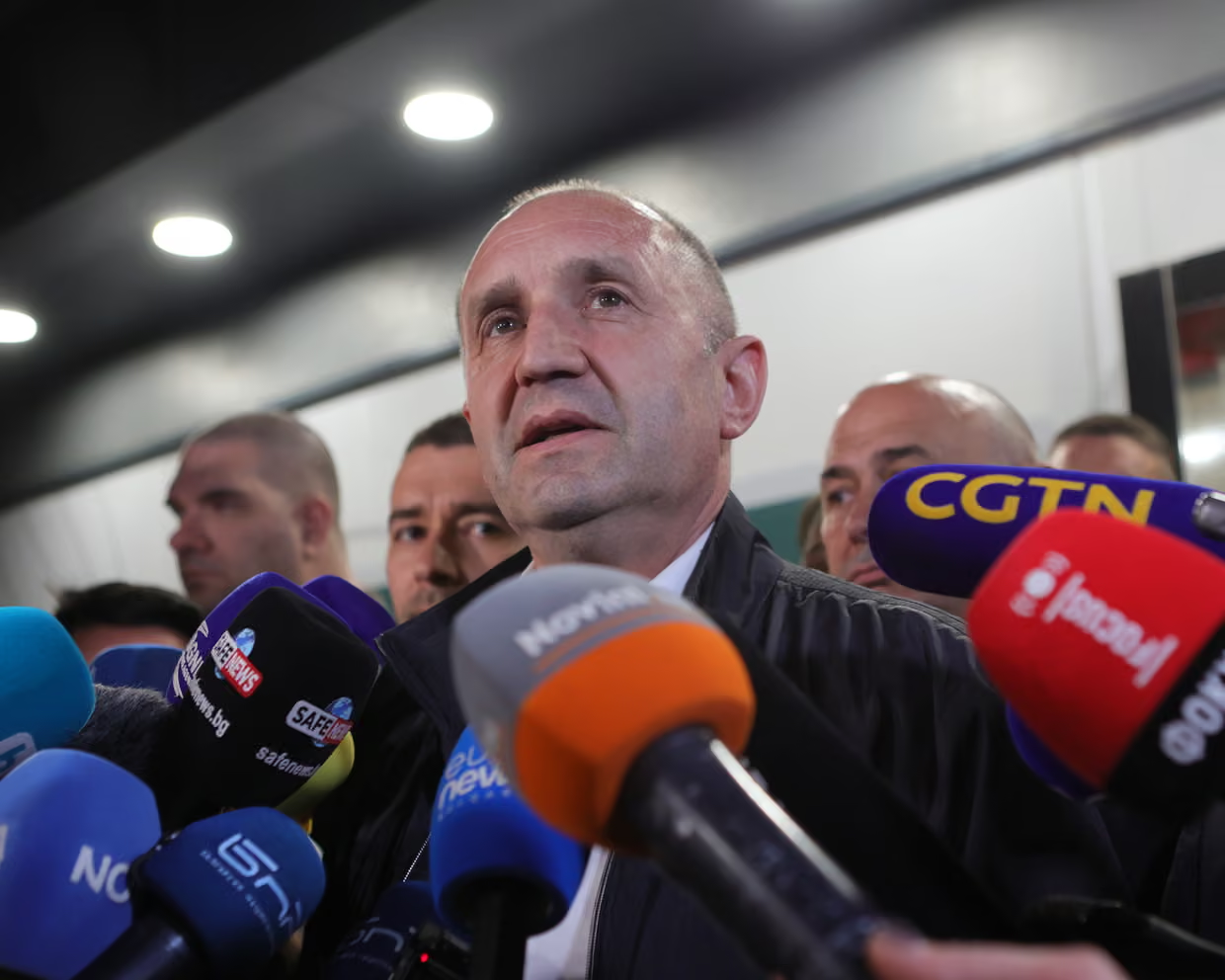
The eighth parliamentary elections in five years in Bulgaria have led to a political earthquake. The Progressive Bulgaria coalition, led by former President Rumen Radev, won a landslide victory. The new formation received 44.5% of the vote and an absolute majority of 131 deputies in the 240-seat National Assembly.
How did we get here?
In January, Rumen Radev took an unprecedented step by resigning as president and announcing that he would participate in the upcoming snap elections. This decision was in response to calls for him to participate in the upcoming snap elections, using his high public rating for political change. The parliamentary crisis in Bulgaria in recent years has led to a political deadlock – short governments and sharp political confrontation. Attempts by new parties that emerged after the 2020 protests to offer an alternative and an effective fight against corruption have proven unsuccessful, due to parliamentary fragmentation and unacceptable political compromises, which have led to disappointment among voters. Therefore, Radev’s success can be explained by the 5-year political crisis and the inability to achieve sustainable governance.
The main topic that Radev focused on during the election campaign was the fight against corruption and the dismantling of the oligarchic model of state captured. The program of Progressive Bulgaria was aimed at various groups of Bulgarian society – from the most vulnerable and poor segments of the population, affected by inflation, to Russophile- oriented and Eurosceptic voters.
Party system change
The snap elections led to a significant transformation of the party system. The participation of Progressive Bulgaria (PB) in the elections proved disastrous for smaller parties, whose voters shifted towards the new contender. The oldest historical party, the Bulgarian Socialist Party (BSP), received only 3% of the vote and thus remained outside parliament for the first time since the democratic changes in 1989. The BSP, which nominated Radev for president in 2016, and which supported him for a second term in 2021, was practically absorbed by PB. Its participation in a joint coalition with the Citizens for the European Development of Bulgaria (GERB) in the government of Rosen Zhelyazkov, which was overthrown by protests last year, proved disastrous for the BSP. For many years, the Socialists were GERB’s main opponent, so a large part of BSP supporters could not come to terms with this compromise. Smaller Eurosceptic and populist parties such as (Morality, Unity, Honor” (MECh) and Velichie, which were previously part of the National Assembly, also remained below the 4% electoral threshold. The far-right and pro-Russian party Vazrazhdane lost two-thirds of its voters, who also preferred Radev’s coalition in these elections. Vazrazhdane received 4.2% of the vote and will be the fifth and smallest parliamentary group with 12 MPs.
The center-right GERB party suffered a heavy electoral defeat. The party collapsed to 13.3 % of the vote – the lowest result for the party ever. In recent years, GERB has become a clientelist party, clearly tied to the Movement for Rights and Freedoms (DPS), led by oligarch Delyan Peevski, who was sanctioned under the Magnitsky Act. The two parties imposed political control over the prosecutor’s office, which refuses to investigate the corruption crimes of their representatives. In fact, the government of Rosen Zhelyazkov was supported by the DPS, and thus the long-standing connection between the two parties along the lines of certain business interests became even more visible. The DPS also achieved a lower result than expected. In these elections, 7.1% voted for the DPS, while in the previous elections they were supported by 11.5% of voters.
What’s next?
Expectations for the new Rumen Radev’s government are contradictory. The fears of several observers are that “Orbanization” may occur in Bulgaria in view of the former president’s pro-Russian positions and his soft Euroscepticism. Such a scenario is possible, less likely, because a large part of Radev’s voters is pro-European and he could quickly lose their support in the event of a sharper geopolitical turn. This would lead to new protests, which a pragmatist like Radev hardly wants at the beginning of his mandate. The second main issue that can be quickly resolved is the election of a new Supreme Judicial Council, which will elect a new prosecutor general – a key issue for anti-corruption policies. Radev’s government will have a solid parliamentary majority, which can be used to implement much-needed reforms in the judicial system to fight corruption and restore the rule of law in the country. This is an issue on which the Progressive Bulgaria party can also count on a broader majority, which would also include We Continued the Change-Democratic Bulgaria (PP-DB), which received 12.8% of the votes and will have 37 MPs. Two coalitions have the necessary two-thirds majority of 160 МРs needed to elect the parliamentary quota of the Supreme Judicial Council and its Inspectorate.
The impressive victory of PB is a guarantee that the next parliamentary elections in the country will not be soon. This is the more likely scenario. The de-institutionalization of the party system in Bulgaria in recent years, the frequent emergence of new and new contenders, we must keep still in mind this experience.
Photo source: https://www.theguardian.com/world/2026/apr/19/bulgaria-election-rumen-radev-boyko-borissov