

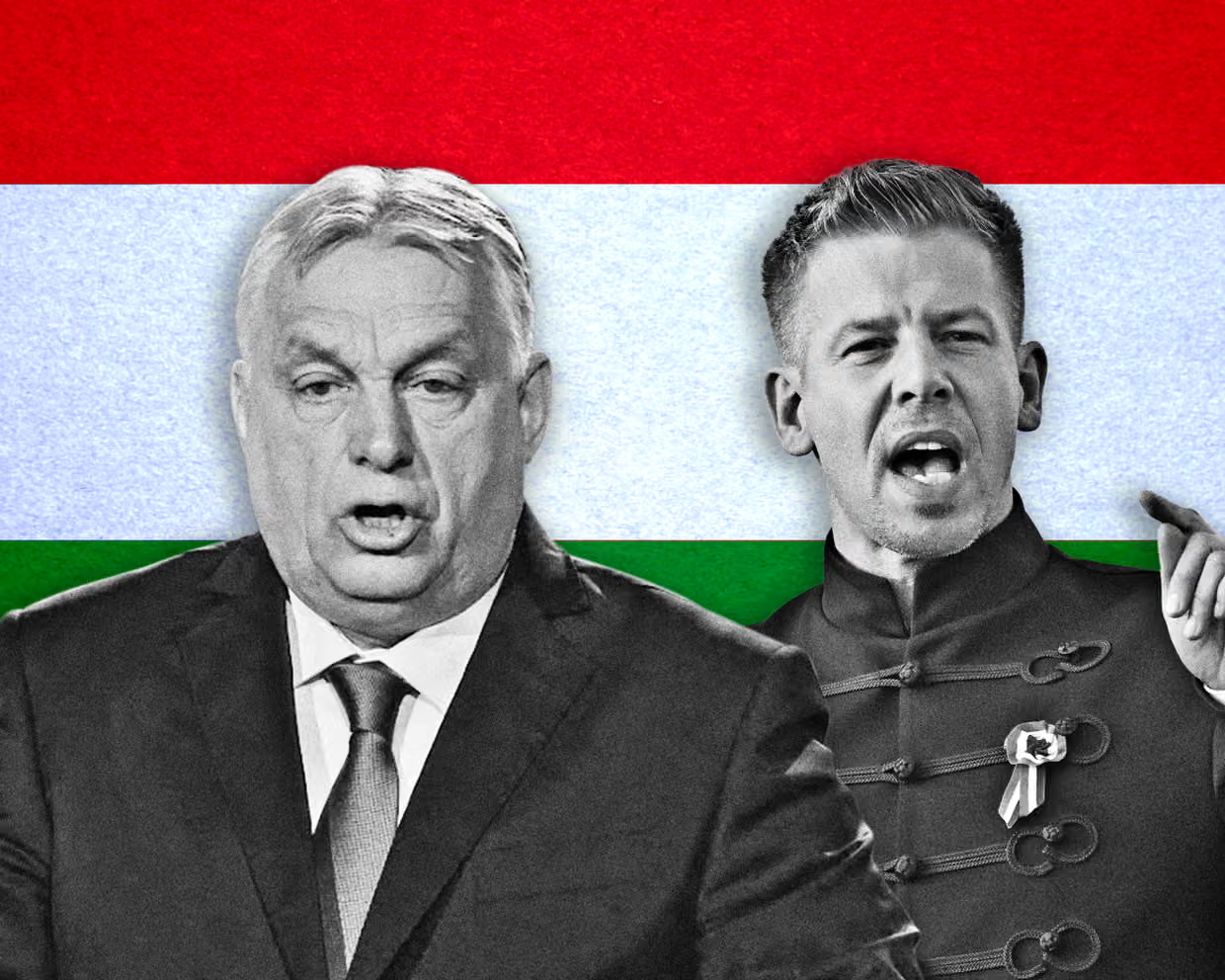
By Daniel Oross (ELTE Centre for Social Sciences of the Hungarian Academy) and Bálint Mikola (CEU Democracy Institute)
Since 2010, Hungary has been controlled by the illiberal politics of Viktor Orbán and his party to such an extent that the main issue leading up to the 2026 elections was whether Hungary can still be seen as a democracy. Controlling simultaneous crises,without losing substantial support, the same group of political parties (Fidesz-KDNP) won four elections in a row with a supermajority, and the government kept expanding its control over more and more areas of daily life.
However, illiberal systems can also be fragile. When they fail, it is often due to their inability to manage economic crises and internal scandals, or an overreach that causes them to lose support among more moderate voters. Fidesz’s decline started because of several reasons working together. A critical turning point came in February 2024, when revelations that President Katalin Novák had pardoned a man involved in the cover-up of a child sexual abuse case led to her resignation. Former Minister of Justice Judit Varga, who had signed the pardons, also resigned from her parliamentary position and from her role as leader of the Fidesz list for the European elections. The episode greatly weakened Fidesz’s long-held arguments about family values and created an opportunity for a new political figure, Péter Magyar, who is the ex-husband of Varga. His first action was to start an anti-government demonstration on March 15, which is a national holiday remembering the 1848 Revolution and the War of Independence from Habsburg rule. Since then, the liberal-conservative opposition movement Respect and Freedom Party (Tisza) led by Magyar has grown to the point of threatening the illiberal incumbents.
The 2026 parliamentary elections happened in an institutional context where the dominant party (Fidesz-KDNP) enjoyed the opportunities of an uneven playing field (in terms of media access, campaign resources) and ran in an electoral system that is biased towards the biggest party. However, parliamentary opposition parties became insignificant by the 2026 elections as most opposition candidates withdrew in order to maximise the chances of defeating Orban and the emergence of a single challenger (Tisza) has changed the status quo. Peter Magyar became a credible challenger and framed the 2026 elections as a potential turning point after democratic decline, giving high domestic and international stakes.
The campaign period that preceded the 2026 general elections was unprecedented from several respects. First, despite its disproportionate control over resources, Fidesz led a weak and fragmented campaign. Some of this may be attributed to the new EU regulation on the transparency of political advertising, due to which paid social media campaigns were not allowed on Meta and Google platforms that Fidesz previously championed. However, they also lacked an original message and recycled their 2022 narrative suggesting that an opposition victory would lead to Hungary’s inevitable drift into the war in Ukraine. Orbán entered the campaign late and reluctantly, faced with a much more energetic opponent who visited all electoral districts in the country and even did a walking tour to Transylvania, a former Fidesz stronghold. Moreover, beyond the more authentic communication strategy of Tisza, opposition mobilisation was also aided by a series of investigative articles published by independent media during the campaign period which revealed state authorities’ neglect towards child abuse cases, workplace pollution in an electric battery plant, the Hungarian government’s subservient attitude towards Russia, as well as secret service meddling into the Tisza Party’s IT infrastructure. For the first time in 16 years, Fidesz was on the defensive, and kept receiving new hits on a weekly basis. By the run up of the elections opinion polls have shown Tisza leading ahead of Fidesz and some seat projections referring to the percentage results of various polls have predicted that even 133 seats that are needed for a two-thirds supermajority to amend the Constitution of Hungary was possible for Tisza party.
The election results mirrored expectations: Tisza won with a landslide, securing 141 of the parliament’s 199 mandates, with 53.18 per cent of the PR votes and winning 96 out of the total 106 single member districts. This yields an unprecedented majority in parliament, and an exceptionally strong popular legitimacy due to the record-high participation rate of 79.69 per cent (83.1% in Budapest). Fidesz won only 52 mandates, and already announced that some of its lead candidates, including Viktor Orbán will not use their mandate. Thanks to the larger share of female candidates on Tisza’s list, gender proportions in the new parliament will change drastically, elevating the share of women MPs from 14.1 to 25.6 per cent. The election night turned into a spontaneous street festival in Budapest, echoing the atmosphere of the 1989-1990 democratic transition.
The political mood in Hungary changed instantly after the elections. New ministerial appointments suggest that the incoming cabinet will include technocratic experts with a policy-oriented reformist agenda. Negotiations with the EU about the unfreezing of funds to Hungary are underway, and the international reception of the change has been overwhelmingly positive. The new government will have a strong mandate to restore democratic checks and balances and the neutrality of the previously extremely partisan public media, both of which will require changes in executive positions. It will also need to make steps to tackle high-profile corruption cases the prosecution services have failed to investigate so far, even though holding key political leaders accountable will likely be challenging. More importantly, it remains to be seen whether access to EU funds combined with investors’ optimism can revitalize an otherwise sluggish Hungarian economy that is burdened with a high public deficit and the lack of diversification in terms of energy sources and industrial output. Key legislative changes, such as changing the constitution and the electoral law, might be necessary but need to be based on broad societal support, which Tisza has pledged to ensure via referenda. Under the new political context, Hungary has a chance to reintegrate into the core of the EU, as well as to boost its national economy, but the road will be rugged.
Photo source: https://www.theguardian.com/world/2026/apr/03/hungary-elections-viktor-orban-who-will-win