

By Kaltrina Beqiri (Independent scholar, graduated at the University of Prishtina)
Four years ago, Kosovo appeared poised to enter a more mature phase of its democratic development. Free and competitive elections raised expectations that a new political chapter was unfolding. Today, however, the country finds itself in a state of democratic overdrive—moving restlessly from one election to the next, with little time for governance in between. In the current year alone, Kosovar citizens have been called to the polls on four separate occasions.
Perpetual Campaigning and Its Costs
This cycle of continuous elections has exacted a heavy toll. Beyond the direct financial burden of organizing repeated votes, the far greater cost lies in political stagnation and missed opportunities. Months of uncertainty have translated into delayed reforms, stalled decision-making, and growing institutional fatigue. Of particular concern is Kosovo’s potential inability to ratify key agreements linked to the EU’s Growth Plan for the Western Balkans, a failure that could jeopardize access to much-needed financial support.
Following earlier elections—where Prime Minister Albin Kurti’s party suffered a loss of more than 40,000 votes—the formation of a stable government proved elusive. Political life largely ground to a halt, while preparations for yet another electoral contest quietly began. The opposition’s inability to construct a viable coalition ultimately compelled the President to dissolve parliament and call new elections.
The timing of these elections was notably advantageous for Kurti’s Vetëvendosje (LVV). Held at the end of the year, they coincided with the return of large segments of the diaspora for the winter holidays. Diaspora support for Kurti has long been well documented: ballots cast through diplomatic missions favored LVV by more than 86 percent. Voters who returned to Kosovo in person largely mirrored this pattern.
This dynamic raises a legitimate question: to what extent should the votes of citizens who reside abroad—and are not directly affected by Kosovo’s daily political and institutional realities—shape domestic political outcomes? Prime Minister Kurti has successfully mobilized the diaspora by fostering a renewed sense of political inclusion. This has translated into overwhelming electoral support. While the diaspora remains a vital part of Kosovo’s national fabric, its decisive influence complicates questions of democratic balance, as those living abroad do not bear the immediate consequences of governance. This is not an argument against diaspora participation, but a reflection on representation and proportional influence in Kosovo’s electoral system.
The final results reflected these dynamics, Kurti once again surpassed the 50% threshold. The final turnout figures even surpassed those recorded in the 2021 elections. Late-stage campaign pledges—such as a thirteenth salary for public sector employees and one-off €100 payments for children, students, and pensioners—though widely criticized, clearly resonated with parts of the electorate.

An Uneven Political Field
Kurti’s renewed success was facilitated by the absence of a compelling opposition. None of the rival party leaders were able to challenge him on equal terms, either in political stature or public appeal. The Democratic Party of Kosovo (PDK), still overshadowed by the indictments of its former leadership in The Hague—including former President Hashim Thaçi and former parliamentary speaker Kadri Veseli—struggled to maintain voter confidence. Nevertheless, under the leadership of former minister Memli Krasniqi, the PDK increased its vote share by nearly 50,000 between 2021 and 2025. The eventual return of its former leadership figures may yet alter the party’s trajectory and pose a more serious challenge to Kurti.
The Democratic League of Kosovo (LDK) experienced a comparable rise under the leadership of former minister Lumir Abdixhiku, gaining over 60,000 votes between 2021 and 2025. This momentum, however, failed to translate into sustained electoral support in the most recent vote on December 28, where only a fraction of these gains remained. Although both Krasniqi and Abdixhiku are relatively young, they are nevertheless entrenched figures within their respective party structures. Neither has succeeded in presenting a credible leadership alternative capable of rivaling Kurti’s dominance.
For the time being, Kurti occupies the political landscape largely uncontested. Unless the opposition engages in serious introspection and renewal, this imbalance is likely to persist.
Signals from the Electorate
The evolving composition of parliament offers important insights into voter sentiment. While some established figures secured re-election, others were decisively rejected, making room for new political actors. This constitutes a clear message: voters are demanding internal party renewal. Kurti’s ascent would not have been possible on this scale without the opposition’s failure to respond effectively. Persisting with discredited names while facing fresh candidates on LVV’s lists has proven politically self-defeating.
This trend is particularly evident within the PDK, where—beyond party leader Bedri Hamza—the most successful candidates are newcomers to national politics. In contrast, the LDK displays a different pattern. Candidates closely associated with the party’s historical roots, including relatives of former leaders, fared better than newer figures who had entered parliament earlier in the year but failed to secure re-election. This suggests a segment of the LDK electorate is seeking a return to the party’s traditional identity, even as the broader optimism seen earlier in the year has dissipated.
New political figures who remain faithful to party values while articulating a modern and credible governing vision represent the most plausible path toward a more balanced and pluralistic political landscape. For the Alliance for the Future of Kosovo (AAK), the need for renewal is particularly urgent. Having narrowly surpassed the five-percent threshold, the party risks political marginalization unless it undertakes meaningful generational change.
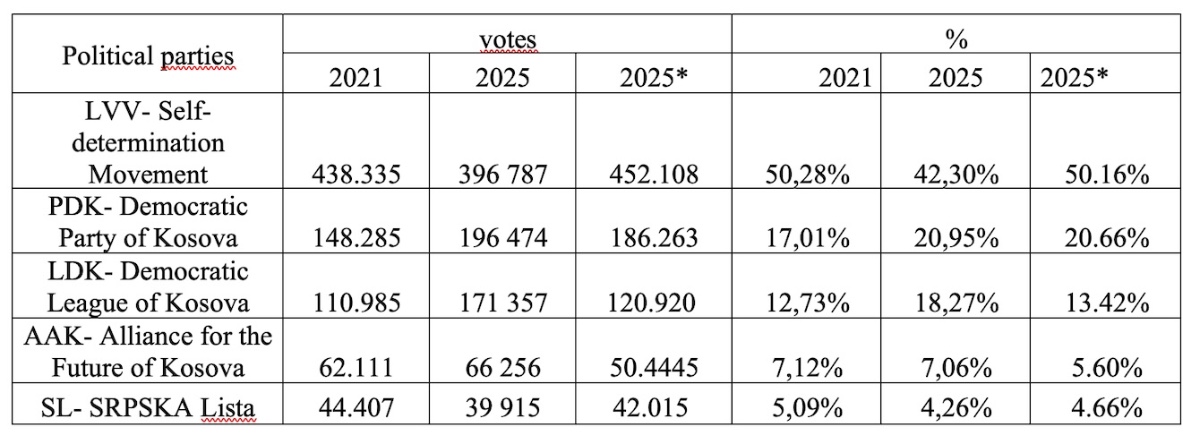
As can be seen from the voter figures between the elections held earlier this year and the most recent vote, there are clear indications that the Kosovar electorate is losing interest in participating in political processes. It is important to note that diaspora participation was relatively high in this election; yet despite this, more than 60,000 fewer voters took part.
Without the involvement of the diaspora, overall voter turnout would have been even lower—underscoring the depth of voter disengagement within the resident electorate.
This development raises a fundamental question: if political parties continue to resist reflection, renewal, and meaningful engagement with an increasingly disillusioned electorate, who will still turn out to vote? And more critically, how democratic—and how representative—will Kosovo’s political system truly be four years from now?
The Old–New Government and the Challenge Ahead
As a single-party government, LVV might be expected to govern with clarity and efficiency. The experience of the past four years, however, suggests otherwise. Few major infrastructure or reform projects have been initiated or brought to completion. At a time marked by geopolitical uncertainty, economic pressures, and heightened security concerns, Kosovo requires more than electoral legitimacy. It needs a government that is both stable and effective—one capable of delivering tangible results, assuming responsibility, and fostering a more constructive political discourse across party lines.
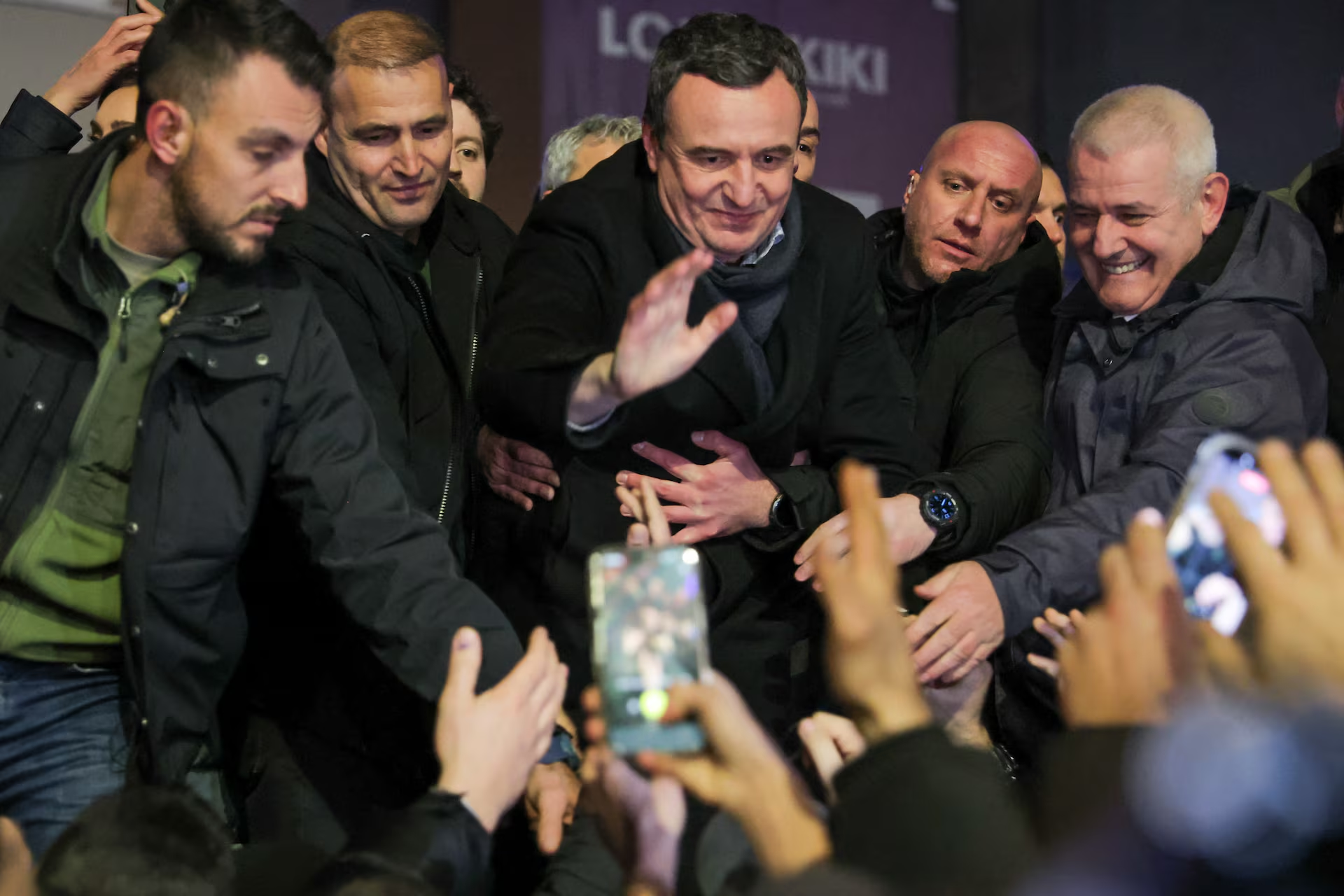
Photo source: https://www.reuters.com/world/kosovo-votes-bid-end-year-long-political-impasse-2025-12-28/