

By Roderick Pace (University of Malta)
The Labour Party (Partit Laburista, PL) secured a comfortable parliamentary majority in the general election held on Saturday, 30 May. Prime Minister Robert Abela was sworn in for another term on Monday morning. While the PL finished ahead by just under 22,000 votes, the Nationalist Party (Partit Nazzjonalista, PN) registered significant gains across all 13 electoral districts. This shift came largely at the expense of PL, which suffered a notable haemorrhage of support. Although turnout improved slightly compared to 2022, about 44,000 voters stayed home and 6,000 invalidated their ballot despite a deluge of electoral pledges – suggesting that public dissatisfaction may be rooted in deeper issues than mere material concerns.
The campaign was short and followed the familiar patterns that have characterised Maltese politics since independence in 1964. Once again, it was a two horse race between the PL and the PN. Smaller parties failed to break through the entrenched duopoly and remained outside the House of Representatives. The two major parties together captured 96.5% of all votes cast, leaving the remainder to four minor parties and two independent candidates.
Female candidates performed slightly better than in previous elections: 12 seats were captured by women, compared to just five in 2022 before the gender balance mechanism was triggered. Notably, two incumbents – Miriam Dalli (PL) and Rebekah Borg (PN) – were elected in two districts each, demonstrating that, despite structural disadvantages, women can succeed when they build strong personal and political profiles.
A defining feature of this campaign was the performance of Alex Borg, the PN’s new leader, elected in September 2025 to replace Bernard Grech. Borg succeeded in galvanising a party that had been adrift since its heavy defeat in 2013, a period marked by internal turmoil and the rise and fall of three successive leaders. Born in Gozo (1) and popular there and in Malta, the election may have come too early for him to overturn the PN’s longstanding vote deficit. The PN argues that the election was called a year prematurely, before Borg could consolidate momentum. Yet this claim must be weighed against the broader context: Malta’s economy continues to perform strongly, driven by a buoyant tourism sector, despite the less palatable side effects of rapid growth, such as rising inflation, over tourism, increased foreign labour, pressure on housing affordability, waste management challenges, traffic congestion, and longer hospital waiting lists.
Both major parties focused their campaigns almost exclusively on domestic issues, sidelining foreign policy despite a deteriorating international landscape and the economically threatening stalemate in the Strait of Hormuz. While both sides made expansive promises to key voter demographics, the PL leveraged its incumbency to influence the electorate with highly questionable pledges. The sprawling manifestos of both main parties proved too dense for many core supporters to digest, leading voters to rely on partisan cues rather than independent analysis. Meanwhile, smaller parties issued more concise platforms, but their messages were drowned out by the dominant PL–PN rivalry and failed to penetrate public debate. Ultimately, ideology was eclipsed by a politics of personal allegiance, with populism heavily overshadowing more restrained electioneering.
Detailed Result
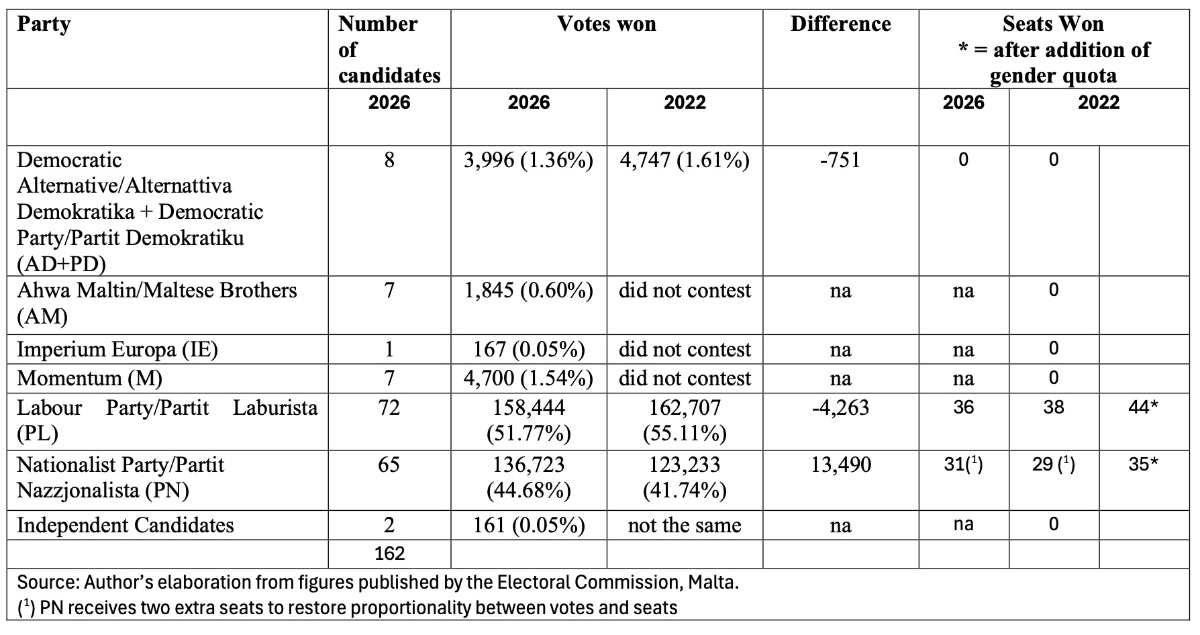
The 2026 Maltese general election was officially announced on 27 April 2026. Under Malta’s constitution, strongly influenced by the Westminster model – the Prime Minister may call an election at any time, and both major parties were fully prepared to launch their campaigns immediately. The parties, independent candidates, and their respective vote totals are listed in Table 1. As in previous elections, only the Labour Party (PL) and the Nationalist Party (PN) secured parliamentary representation. In 2026, the initial seat difference between the two parties stands at five seats. This margin will not change once the casual elections are held to fill the seats of candidates elected in two districts, followed by the application of the gender corrective mechanism, which can add up to 12 additional seats. However, the size of the parliament will change when these procedures are completed.
Table 1: Main Result of the 2026 election compared: Candidates, Votes and Seats
The gender corrective mechanism
Introduced in 2021, Malta’s constitutional gender corrective mechanism is activated once casual elections are concluded. If the under represented gender – historically women – constitutes less than 40% of Parliament, the Electoral Commission automatically allocates up to 12 additional seats. These seats are awarded strictly to the highest ranking unelected female candidates from the two major parties, the PL and PN. In the 2022 election, the mechanism reached its maximum allocation, adding 12 women to the House. Given the initial 2026 results, it is widely expected that the mechanism will again be triggered to its full extent, raising female representation closer to the 30% threshold.
The electorate, turnout and polling
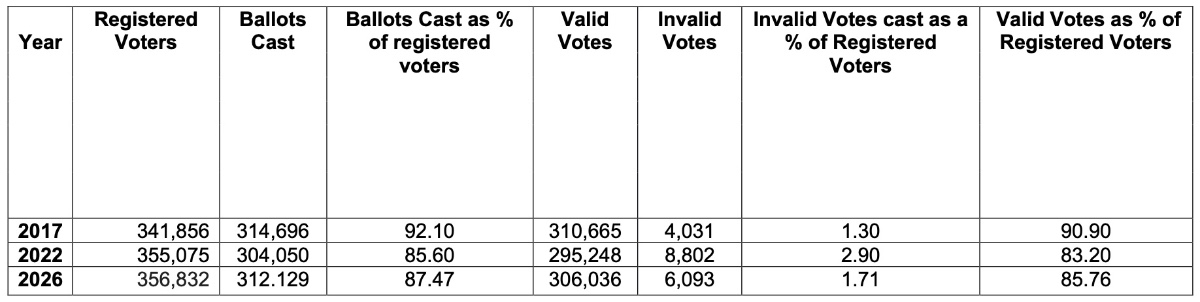
The number of registered voters increased by just 1,757 compared to the 2022 election. This marginal growth reflects a clear stagnation in Malta’s native citizen population, driven by persistently low fertility rates over the past two decades. In fact, between 2012 and 2024, the Maltese citizen population grew by only 1.8%, with overall national growth being heavily sustained by foreign immigration. Despite this demographic plateau and pre-election surveys predicting a suppressed turnout – with polls from Malta Today and The Sunday Times of Malta anticipating turnouts as low as 77.3% to 84% (Table 2) – actual voter turnout reached 87.5%, a slight increase from the 85.6% recorded in 2022. Notably, the electorate would have been considerably smaller had the voting age not been lowered to 16 in 2015, a legislative reform that expanded the voter pool for both the 2022 and recent elections. The final data on turnout is summarized below in Table 3. The opinion polls reveal some consistent trends, the main one being that the PL was on the way to victory.
Table 2: Summary of some key Pre-Election Surveys
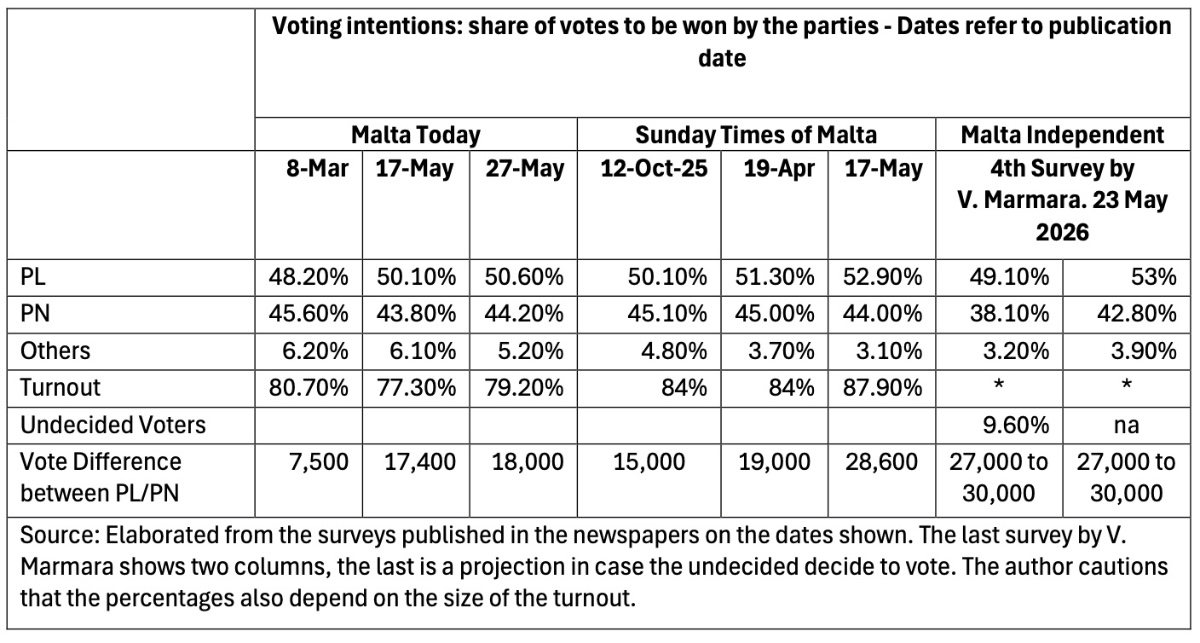
However, these polls still courted controversy. Malta Today proved highly accurate, but competing surveys offered overly optimistic PL forecasts that critics feared would manipulate the electorate. Specifically, they pointed to the “bandwagon effect” driving unengaged voters toward the projected winner, alongside an “underdog effect” that demobilized voters who felt the race was already decided. These 2026 discrepancies mirrored the polling failures of the 2024 European Parliament elections, ultimately intensifying public skepticism in the polls.
Table 3: Registered Voters, Ballots Cast, and Valid and Invalid Votes,1962-2026
The Campaign and the Manifestoes
While both major parties built their campaigns on extensive electoral manifestos, the brief campaign window forced them to concentrate on a few high-stakes issues designed to capture voters by proposing additional welfare benefits for pensioners and new home buyers, green spaces, bonuses for workers and a new mass transport system – with the PN pledging to implement the major part of such a system within five years. This section first evaluates briefly the proposals of the two main parties, given that the PL-PN duopoly thoroughly dominated the campaign.
The Labour Party’s (PL) 2026 manifesto, titled “Int Malta” (“You are Malta”), spans 268 pages and marks a distinct shift from its 2022 focus on post-pandemic recovery and stability toward an intergenerational, 25-year strategic roadmap. While the 2022 document was anchored in maintaining economic certainty amidst international crises, the 2026 framework leverages Malta’s current economic growth as a springboard for long-term transformation. This vision transcends the traditional five-year electoral cycle, pivoting from a paradigm of “recovery and stability” to a “Quality Leap” (Qabża ta’ Kwalità) designed to redefine national prosperity through the lens of holistic wellbeing. Crucially, the 2026 manifesto proposes a “Wellbeing Index” to ensure that national wealth translates into tangible improvements in citizens’ daily lives, serving as a primary governance metric to complement traditional GDP indicators.
The PN’s manifesto, “Nifs Ġdid” (“A Fresh Start”), is a 344-page document that emphasizes a shift from volume to value. Championed by the new party leader Alex Borg, the PN’s vision represents a strategic turn away from the current administration’s growth model, which relies heavily on the mass importation of labour and high-volume tourism. Instead, the PN proposes a “value-added” economy that prioritizes quality of life and human capital. This strategy positions the PN as the antidote to a “tired and visionless” PL government, which it accuses of spending 13 years endlessly commissioning studies on transport and energy without delivering tangible results. To break this status quo, the PN commits to significant structural reforms and aggressive tax cuts, framing these fiscal measures as primary catalysts for transitioning into a higher-value economic tier. Central to this “Politics of Hope” is a focus on the value of people, ensuring infrastructure serves the population rather than merely fuelling construction volume.
In their own distinct ways, both manifestos respond to growing public disgruntlement over the negative externalities of rapid economic growth – namely environmental degradation, a strained healthcare system, and overburdened infrastructure, including water supply, waste treatment, and traffic congestion. Ultimately, the true test lies in implementation and the financial cost of this strategic pivot. Over the next five years, the Government will face intense scrutiny regarding its 950 pre-election pledges, while the PN will attempt to maintain its momentum to expand its electoral base. With 950 pledges in the PL’s document and 1,000 in its own programme, the tools to assess political performance – particularly for an incumbent tasked with execution – and the juxtaposition of alternatives are virtually limitless.
The Smaller Parties
The smaller parties ultimately failed to break the mold and secure parliamentary representation. The green party, AD+PD, saw its vote share decline by 751 votes compared to its 2022 result. Meanwhile, two newly formed political parties – Momentum (M) and Aħwa Maltin (AM) – obtained 4,700 and 1,845 votes respectively. Collectively, these three minor parties captured 3.5% of the total votes cast. This outcome underscores how the Maltese single transferable vote (STV) system fails to achieve true proportional representation. Because there is no national quota, a party can only enter parliament by winning a seat/s within one or more of the 13 five-member electoral districts. Compounding this barrier, the constitutional proportionality and gender corrective mechanisms apply exclusively to parties that have already successfully entered parliament – invariably limiting their benefits to the PL-PN duopoly.
Reflecting this systemic hurdle, AD+PD’s 50-page manifesto, containing 49 proposals, prioritizes constitutional amendments to dismantle this status quo by extending the proportionality principle to parties that perform well nationally despite failing to secure a district seat. Centred on building a fairer, greener, and more accountable Malta, the manifesto argues that the political system is structurally flawed and dominated by patronage. AD+PD calls for deep institutional reform to end clientelism, alongside environmental priorities like protecting open spaces, transitioning to renewable energy, and insulating planning decisions from political interference. Social justice also features prominently through proposals for affordable housing and equitable taxation, packaged within a long-term economic strategy focused on quality of life over speculative growth and rent seeking.
Momentum’s (M) manifesto (259 proposals across 69 pages) sets out a similarly ambitious reform agenda. It proposes sweeping anti-corruption measures, such as empowering the Anti-Corruption Commission and mandating that all magisterial inquiries be made public. To shift away from the construction-dominated status quo, Momentum advocates for a two-year moratorium on high-rises and the reclassification of undeveloped rationalized land back to Outside Development Zones (ODZ). M’s economic platform emphasizes innovation, extensive housing reforms, and the phased introduction of a €360 weekly living wage over four years.
In contrast, Aħwa Maltin (AM) campaigned on the right-wing populist slogan “Malta for the Maltese”. The party criticized the gender corrective mechanism, claiming it exclusively serves female candidates from the two major parties. AM’s platform focused heavily on addressing overpopulation and implementing strict immigration controls to preserve Maltese national identity, language, and traditions. Economically, AM promised to support local families and small businesses, while keeping the cost of living stable.
On the far-right fringe, Imperium Europa (IE) fielded just a single candidate and was almost entirely ignored by the electorate, securing a mere 167 votes. The party published no traceable manifesto; in all probability, its radical right-wing voter base was absorbed by the less extreme AM. Ultimately, radicalism of all stripes remains largely sheltered within the PL-PN duopoly, both of which have drifted to the right on issues like immigration. An underlying cultural friction became evident when a Muslim candidate running for the PL was vilified on social media, including by his own party’s supporters. He was ultimately eliminated early in the count, securing just 167 votes in the sixth district and 186 in the seventh.
Conclusion
The 2026 election delivered a clear message. The PL received a fresh mandate while the PN registered gains in every district and the PL lost votes across the board, signalling a national rather than localised shift. Under its new leader Alex Borg, the PN has succeeded in galvanising its base and restoring a sense of competitiveness, narrowing the gap with the PL from roughly 39,000 votes in 2022 to just under 22,000 in 2026. Yet the most striking figure is the 51,000 citizens who chose not to vote or spoil their ballot – an abstention bloc equivalent to around twelve national quotas, had such a system existed. Their absence, combined with the fact that the smaller parties’ manifestoes articulate many of the country’s most pressing concerns, suggests that a significant segment of the electorate feels structurally unrepresented. If many of these non voters are staying away because they perceive the system as unjust or insufficiently open to genuine choice, then the political system is signalling a deeper legitimacy problem that can no longer be ignored.
(1) Alex Borg was instrumental in turning his home district of Gozo where the PL had around 2,530 majority over the PN to one where the PN had a slight majority of around 144 votes on the PL. In the end both parties elected 3 seats each after the proportionality mechanism was applied.
Photo source: https://www.aljazeera.com/news/2026/5/30/voting-ongoing-in-snap-elections-in-malta-governing-party-expected-to-win