

By Nikandros Ioannidis (Cyprus University of Technology)
DISY and AKEL kept every seat, but ELAM doubled its strength, two outsider parties entered parliament, and the president lost most of his original parliamentary support base.
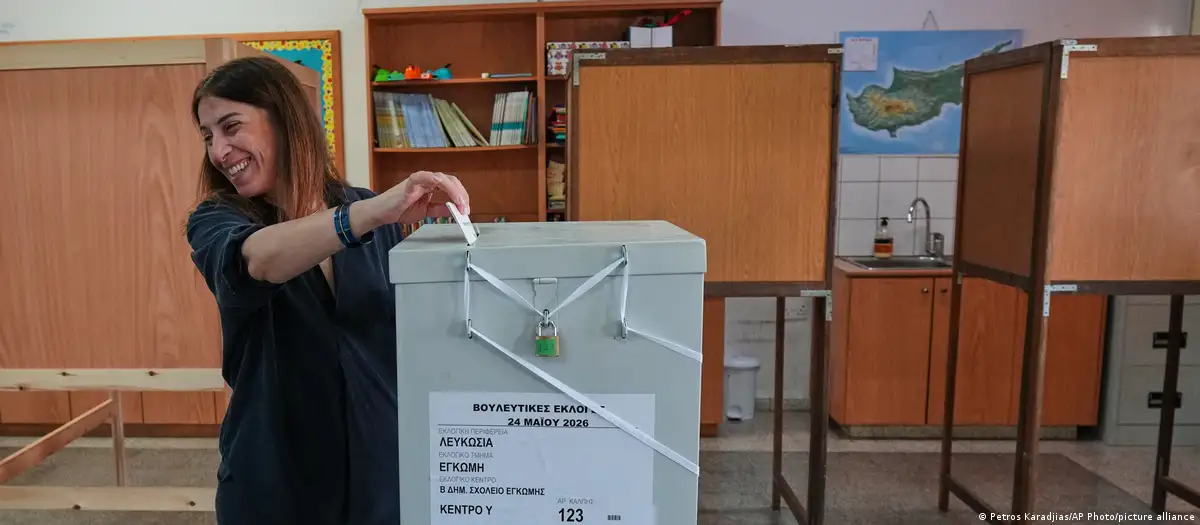
Cyprus’s parliamentary election of 24 May produced a result that was simultaneously reassuring and disruptive. With a turnout of 66.9%, the two parties that have anchored Greek Cypriot politics for decades remained firmly in first and second place. The centre-right Democratic Rally (DISY-EPP) won 27.15% and 17 seats; the left-wing AKEL (The Left) took 23.86% and 15. Both retained exactly the parliamentary representation they had won in 2021.
Figure 1. Ten parties cleared 3%; only six crossed the 3.6% threshold.
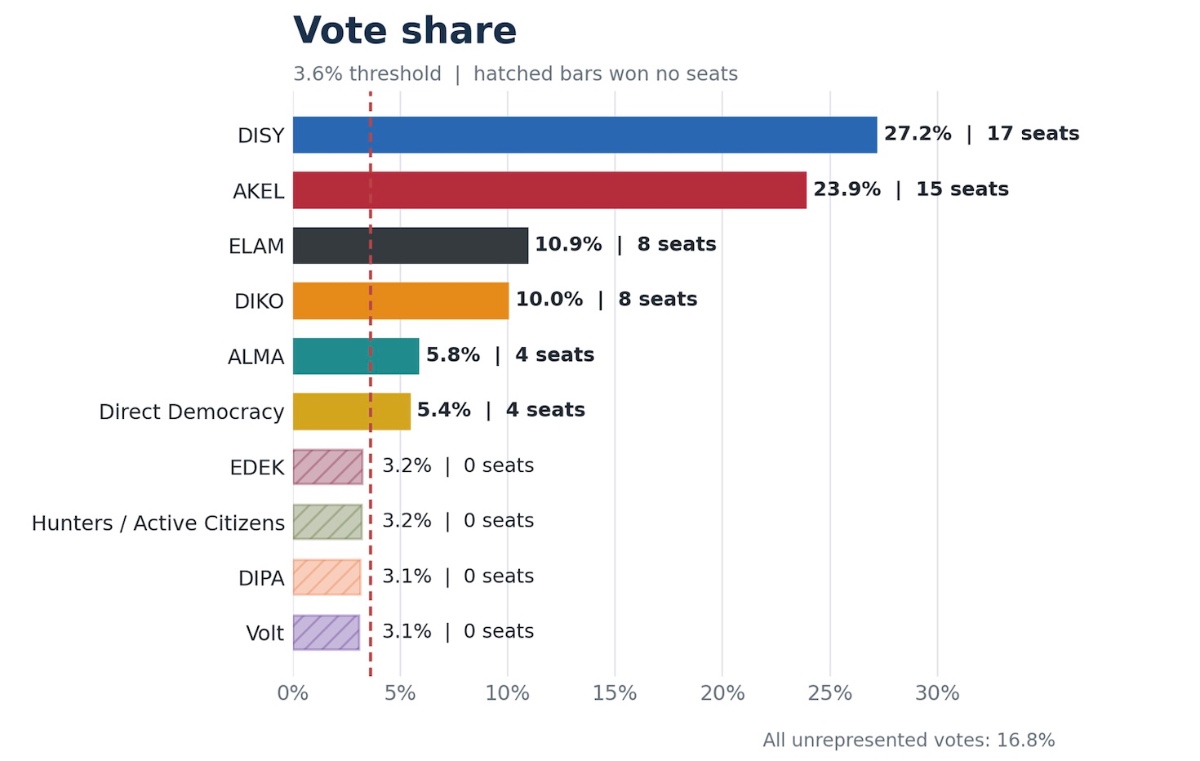
Below them, however, the party system was reordered. The far-right National Popular Front (ELAM-ECR) almost doubled its vote and doubled its seats. Two new formations, ALMA – Citizens for Cyprus (Renew) and Direct Democracy Cyprus (NI), entered the House with four seats each. Three parties represented in the previous parliament – EDEK (S&D), the Democratic Alignment (DIPA-Renew) and the Greens (Greens/EFA) – disappeared from it. Four lists received more than 3% but fell short of the 3.6% threshold. Altogether, 16.83% of valid votes went to parties that obtained no seat.
The result is therefore not a return to the old two-party system. It is a stabilisation of its two main pillars amid continuing fragmentation, weak party identification and intense demand for political alternatives. It also matters for President Nikos Christodoulides (EPP). Cyprus is a presidential republic, so this election did not form or dismiss a government. It did, however, reduce the parliamentary strength of the parties that brought him to the presidency and made future legislation dependent on more fluid bargains.
A system under pressure
The constitutional House has 80 seats, of which 56 are elected by the Greek Cypriot community in six multi-member districts. The 24 seats allocated to the Turkish Cypriot community have remained vacant since 1964. Seats are distributed through a multi-stage proportional system. The first allocation takes place within districts; subsequent allocations redistribute remainders nationally, with thresholds of 3.6% and 7.2% at successive stages. In practice, 3.6% is the decisive entry point.
This institutional detail is important because parliamentary elections in Cyprus do not produce a governing coalition in the usual European sense. The directly elected president appoints the cabinet. Parliament nevertheless passes legislation and budgets, scrutinises the executive and can amend or reject government bills. A president without a dependable majority must assemble support issue by issue. Christodoulides entered office in 2023 as an independent backed principally by DIKO (S&D), EDEK and DIPA. Those parties held 17 seats in the outgoing House. DISY, the president’s former political home, formally occupied the opposition but often supplied votes for major economic, European and foreign-policy initiatives. That arrangement gave the presidency room to manoeuvre between its centrist sponsors and DISY.
At the same time, the social foundations of party politics had been weakening. In the 2001 parliamentary election, DISY and AKEL together received 68.7% of the votes; in 2026 their combined share was 51.0%. The 2024 European election offered an especially sharp warning. Social-media creator Fidias Panayiotou won 19.4% as an independent, while ELAM secured its first European Parliament seat. The route into politics no longer ran only through party branches, trade unions, and youth organisations. Personal visibility and algorithmic reach had become political resources in their own right. Yet dissatisfaction did not simply become withdrawal. Turnout rose from 65.72% in 2021 to 66.91% in 2026. The new competition therefore brought at least some citizens back into the process.
A campaign about trust
The campaign had no single dominant ideological confrontation. Cost of living, housing, electricity prices and pressure on household incomes were common concerns. Corruption, institutional accountability and mistrust of professional politicians supplied the emotional charge. Migration, security and the Cyprus problem remained important, but the contest was increasingly organised around rival claims to competence and moral credibility.
DISY presented itself as the safest vehicle for economic stability, a pro-European foreign policy and institutional seriousness. AKEL stressed a social agenda: cheaper electricity, stronger collective bargaining, housing intervention, taxation of excess bank profits and relief for lower- and middle-income households. DIKO defended a centrist, governing-minded role and its access to the presidency, while trying to resist pressure from both establishment and anti-establishment challengers. ELAM campaigned most clearly on migration, national identity and a harder line on the Cyprus problem. Its message was ideologically sharper than that of the traditional centre-right, but its organisation and media presence increasingly resembled those of a normal parliamentary competitor. Thus, its rise was not simply another fleeting protest vote.
The new parties offered distinct versions of change. ALMA was built around former Auditor-General Odysseas Michaelides and his reputation for confronting corruption and elite impunity. Direct Democracy Cyprus, founded by Fidias only months before the election, promised to transfer political participation to an online, app-mediated relationship between representatives and citizens. Volt offered a progressive, explicitly pro-European and bicommunal reform project. These parties competed for dissatisfied voters, but not for one homogeneous protest electorate: ALMA appealed to institutional reformers, Direct Democracy to anti-political citizens, and Volt to a more urban, liberal and pro-European constituency.
The smaller established parties fought on narrower terrain. EDEK combined social policy proposals on pensions and housing but entered the campaign weakened by internal conflict and declining organisational cohesion. DIPA emphasised the middle class, housing and pragmatic economic management. Active Citizens – Movement of United Cypriot Hunters mobilised a durable rural and sectoral constituency around hunting, access to the countryside and distrust of urban decision-makers. Short videos, podcasts and highly personalised campaigning cut across all these messages. In 2026, social media was no longer an accessory to the campaign, it was the main campaign infrastructure.
The old pillars hold
Table 1. Results
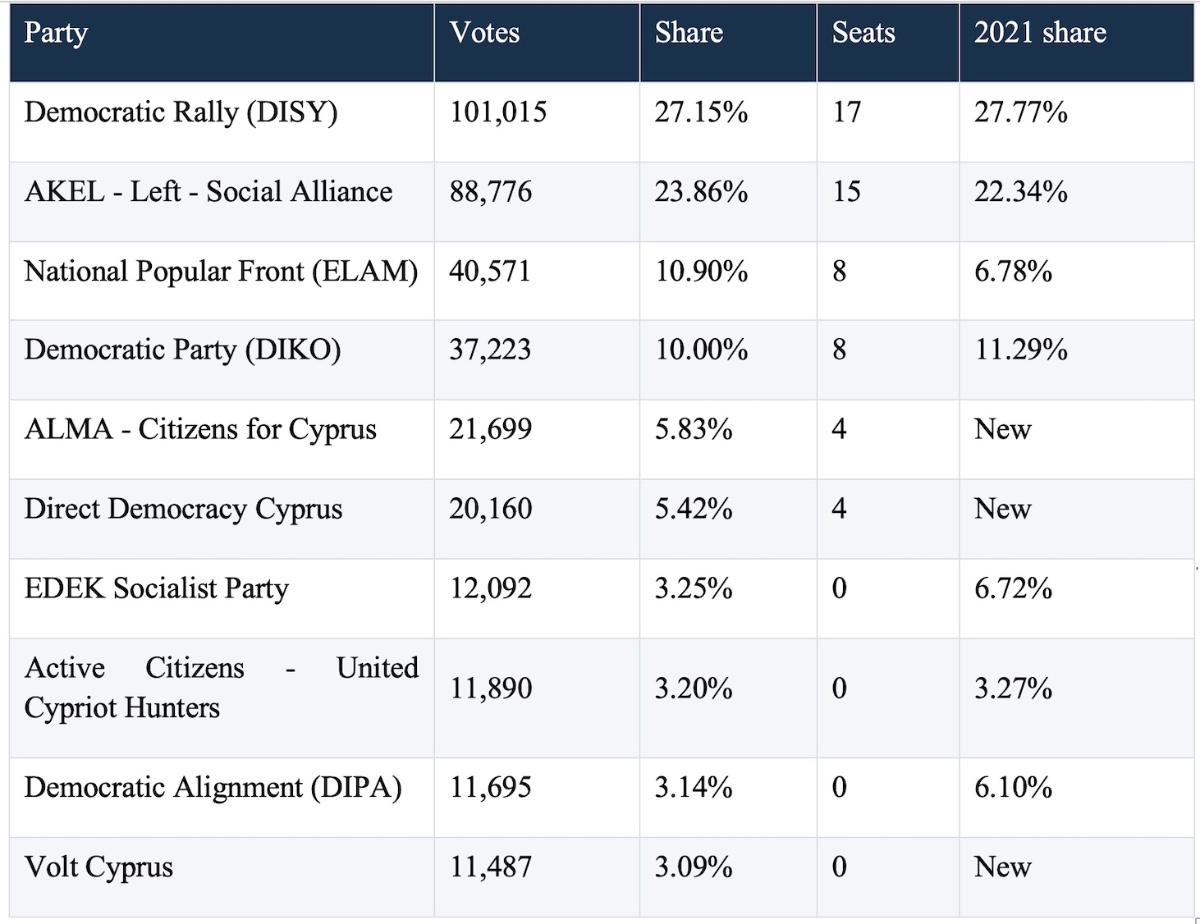
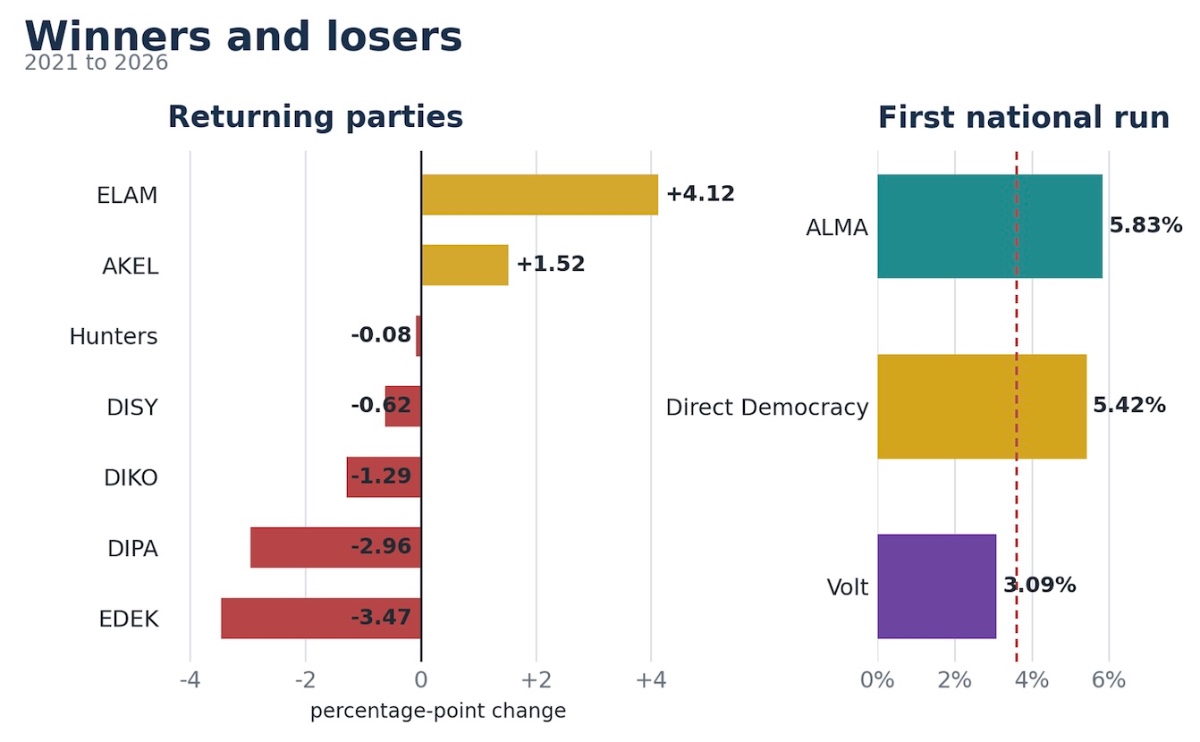
DISY’s result was the election’s first surprise. It lost 0.62 percentage points compared with 2021 yet gained 1,687 votes because of turnout and the number of valid ballots increased. Retaining 17 seats after years of internal strain, the break with Christodoulides and poor expectations was a meaningful victory for party leader Annita Demetriou. DISY remained the largest party and emerged with greater leverage over both the legislative agenda and the 2028 presidential race.
AKEL also retained all 15 seats and improved by 1.52 points, gaining 8,863 votes. This was a recovery but not a restoration: its 23.86% remained far below the levels above 30% that it regularly achieved before 2016. Still, AKEL consolidated its position as the only large party of the left and the principal organised opposition force. In a fragmented field, disciplined organisation continued to matter.
ELAM was the clearest established-party winner. It rose from 6.78% to 10.90%, added 16,316 votes and doubled its parliamentary group from four to eight. It finished with 0.90 points in front of DIKO and took the same number of seats. The result confirms ELAM as a durable third pole rather than a marginal pressure group. Its greater strength will shape debate even when it is excluded from formal agreements, particularly on migration, security and national identity.
DIKO fell from 11.29% to 10.00% and from nine seats to eight, its weakest parliamentary vote in history. Yet the result also preserved its strategic relevance. DIKO is now the only one of Christodoulides’s three original supporting parties represented in parliament. Its eight MPs can complete several different majorities, making party leader Nicholas Papadopoulos a pivotal interlocutor despite the electoral loss.
ALMA entered with 5.83%, 21,699 votes and four seats. Early expectations had sometimes been higher, and the party itself acknowledged disappointment, but a first-election parliamentary group remains a substantial achievement. It institutionalised Michaelides’s anti-corruption appeal and gave the House a new source of pressure on transparency, procurement and executive scrutiny.
Direct Democracy Cyprus followed with 5.42%, 20,160 votes and four seats. This was far below Fidias’s personal 19.4% in the 2024 European election, but it demonstrated that part of his online following could be converted into an organisation with candidates across districts. Fidias chose to retain his European Parliament seat and ceded his national seat to the next candidate. The parliamentary group will therefore test whether a personality-driven, app-based project can develop collective positions and internal discipline without its founder sitting beside it.
Figure 2. Change for returning parties; 2026 shares for first-time entrants.
Four parties stranded
The threshold produced an unusually stark group of near-misses. EDEK received 3.25%, down 3.47 points and 11,930 votes from 2021, and lost all four of its seats. Its exit ended an uninterrupted parliamentary presence stretching back more than half a century. The defeat reflected more than adverse arithmetic: it exposed a crisis of leadership, unity and political identity. Its governing role did not protect it from voters seeking either a clearer ideological offer or a newer vehicle of protest.
The Hunters finished on 3.20%. Their absolute vote was almost unchanged – 11,890, only 178 more than in 2021 – but they again missed representation. Their persistence shows that a stable rural and sectoral constituency exists outside the parliamentary system, even if it is not yet large enough to cross the national threshold.
DIPA fell from 6.10% and four seats to 3.14% and none, losing 10,137 votes. Of all the results, this most directly weakened the presidency. A party whose identity rested on moderation, pragmatism and proximity to decision-making struggled when voters could choose DIKO or DISY for established influence, ALMA for institutional reform or Direct Democracy for a more radical rejection of politics as usual.
Volt won 3.09% in its first parliamentary election under its present form, just 0.51 points short of the threshold. Its 11,487 voters gave Cyprus’s progressive, bicommunal and pan-European current a visible base, but no legislative voice. Volt’s failure, alongside EDEK and DIPA, also shows the strategic difficulty created by fragmentation: four parties above 3% collectively received 47,164 votes, or 12.68% of all valid ballots, and elected nobody.
When votes for every smaller list are included, 62,618 valid ballots – 16.83% – were cast for parties outside the House. The new parliament consequently contains six parties, one fewer than in 2021, despite an electorate that is plainly more fragmented. The electoral system converted dispersed competition into concentrated representation. DISY and AKEL won 57.1% of the seats with 51.0% of the vote; the six represented parties together received 83.17% of valid votes but obtained every seat.
This representation gap is politically consequential because the excluded votes do not belong to one interchangeable camp. They include EDEK’s socially oriented but nationally assertive constituency, DIPA’s pragmatic centre, Volt’s liberal and bicommunal electorate, and the Hunters’ rural protest base. Their absence cannot be reproduced by one parliamentary substitute. It may encourage tactical voting or pre-electoral alliances next time, and it will revive debate over whether the threshold produces too severe a penalty in a presidential system, where parliament does not need to manufacture a governing majority. For the present term, however, these voters can influence politics only indirectly.
No government formation, but new bargains
Figure 3. Six parties now divide all 56 elected seats.
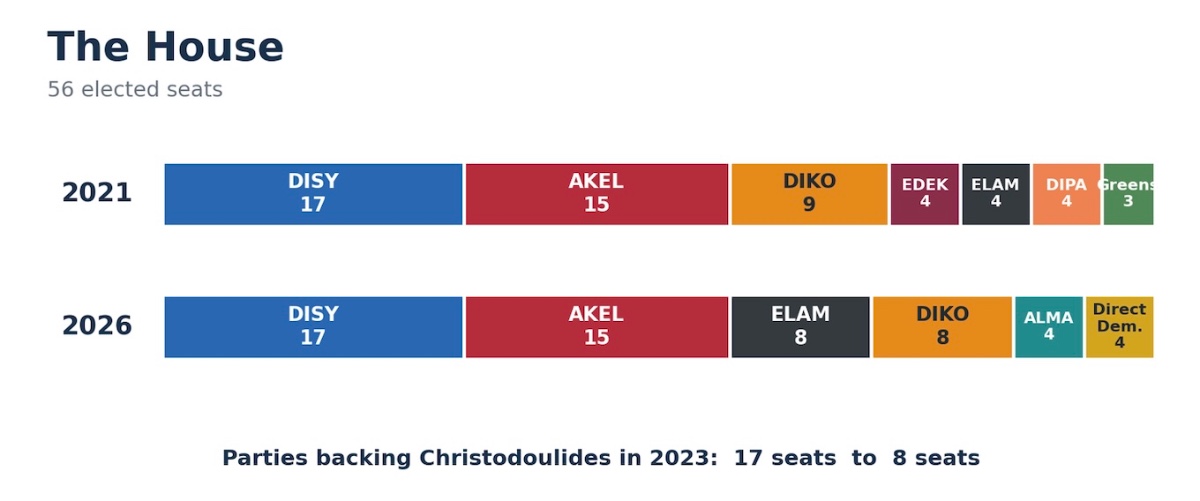
For Christodoulides, the immediate consequence is not a change of cabinet but a narrower starting base in parliament. DIKO, EDEK and DIPA held 17 seats after the 2021 election; only DIKO’s eight remain. The president can still pass legislation, as he often did without a fixed majority before 2026, but each vote now requires a broader and potentially more expensive negotiation.
Table 2. Parliamentary arithmetic
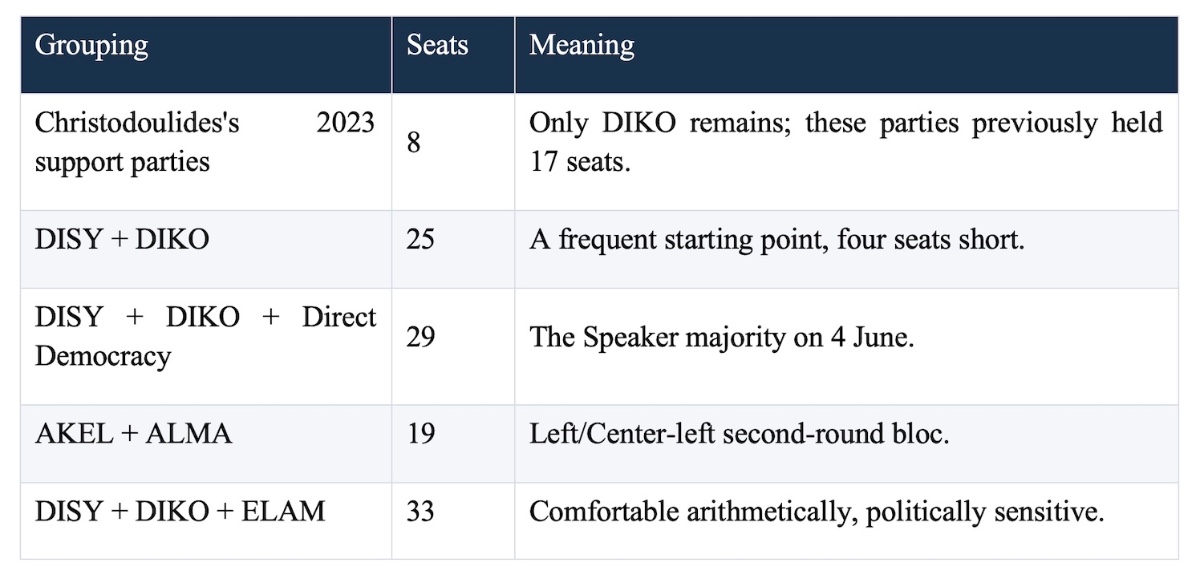
The first major decision of the new House demonstrated the emerging pattern. On 4 June, Demetriou was re-elected Speaker (official title: President of the House of Representatives) with exactly 29 votes: 17 from DISY, eight from DIKO and four from Direct Democracy. AKEL leader Stefanos Stefanou received 19 votes from AKEL and ALMA, while ELAM abstained in the second round after supporting its own leader initially. This was not a governing coalition. It was a transactional institutional majority, assembled for one office and potentially unavailable on the next policy question.
Several routes are therefore open. On economic and European policy, the presidency may continue to rely on DISY, but DISY now has stronger incentives to demonstrate independence and prepare its own presidential alternative for the 2028 presidential election. Direct Democracy’s four MPs can complete a majority, but their app-mediated mandate may make their behaviour less predictable than that of a conventional party. ELAM’s eight seats give it mathematical importance and greater agenda-setting power, even where formal cooperation remains politically sensitive. DIKO, slightly diminished but pivotal, remains the bridge most readily available to the presidential palace.
The result may also pull political competition in two directions at once. ELAM’s advance will increase pressure for tougher positions on migration and security. ALMA and AKEL will push scrutiny, social policy and accountability. Direct Democracy will test whether digitally expressed preferences can be translated into coherent legislative work. The new House is thus less a stable bloc system than a marketplace of shifting majorities.
The 2026 election did not overthrow Cyprus’s established parties. It did something subtler. DISY and AKEL arrested their decline but the traditional middle collapsed; a far-right party became a major parliamentary force; and two very different outsider projects won institutional footholds. The presidency remains in office, yet its original parliamentary coalition has largely vanished. Stability at the top now coexists with volatility below it. That combination, rather than any conventional government-formation story, will define the road to the 2028 presidential election.
Photo source: https://www.dw.com/en/cyprus-voters-boost-far-right-in-parliamentary-election/a-77279514