

By Tara Tepavac (University of Belgrade)
On the night of 25 October, Serbia witnessed a historic political turning point. A student-led movement that had not existed as an electoral actor two years earlier achieved a landslide victory in snap parliamentary elections, wiping away both the ruling parties and most of the established opposition in elections that resembled a referendum on Serbia’s leading political parties. After fourteen years of dominance Aleksandar Vučić, along with his Serbian Progressive Party that steered autocratization in Serbia, was overthrown through the ballot. On the wings of a massive citizen mobilization, the Student List managed to overcome all obstacles of unequal competition in an electoral environment marked by institutional capture, intimidation, repression, extensive media bias and deep polarisation.
According to preliminary results published by Serbia’s Republic Electoral Commission (RIK) on 29 October based on more than 99% of polling stations processed, the Student List won 53.04% of the vote, securing a projected 141 of the 250 parliamentary seats, compared with 38.97% and 103 seats for the SNS-led coalition. The Socialist Party of Serbia (SPS), led by Ivica Dačić, a longstanding fixture of Serbian politics and government running under the moto “Ivica Dačić – Factor of Stability”, failed to cross the 3% electoral threshold. Voter turnout reached 69% with more than 4.43 milion citizens participating, marking one of the highest levels of parliamentary electoral participation in Serbia in decades – similar only to the last revolutionary elections in October 25 years ago when another former autocratic leader, Slobodan Milošević, lost power.
The scale of the victory is remarkable, and so is the process that made it possible. In an era of declining trust in representative institutions and democratic backsliding across Europe and beyond, Serbia’s students demonstrated that even deeply entrenched political power can be challenged by citizens gathered and organized around democratic values. Even more importantly, they have shown how a new type of movement based on horizontal decision-making, solidarity and direct participation can transform widespread frustration and societal distrust into sustained collective political action, and eventually electoral success.
An earthquake in Serbia’s party system
These October elections that fundamentally altered Serbia’s political landscape. For fourteen years, Aleksandar Vučić and his SNS dominated Serbian politics, progressively consolidating control over state institutions, public resources and much of the media landscape. Founded in 2008 following a split from the far-right Serbian Radical Party, the SNS was initially seen by a significant part of international community as a pragmatic, populist but pro-European alternative to its nationalist predecessor. Its declared commitment to EU integration, combined with the expectation that Vučić could deliver politically sensitive agreements to resolve Serbia’s remaining issues with neighbours, helped secure international acceptance and cooperation. Yet, over time the government’s proclaimed commitment to European integration increasingly diverged from its political practices. While continuing to trade promises of reforms and regional stability for international support, the SNS consolidated political power and presided over a steady deterioration of democratic institutions. According to V-Dem, Serbia eroded from electoral democracy to electoral autocracy in 2014, while its autocratisation trajectory had begun even earlier. The decline that followed can be illustrated by the Freedom House’s 2024 report, which underlined that SNS “eroded political rights and civil liberties, put pressure on independent media, the opposition, and civil society organisations”. Against this backdrop, the criticism over continued political accommodation of Vučić by key EU actors grew along with Serbia’s democratic erosion, with scholars and civil society describing EU’s approach as stabilitocracy.
Successive waves of protests and opposition mobilisation challenged this dominance for years, but failed to bring about electoral alternation and change of political power. This time however, a new political actor emerging outside the established party system succeeded where traditional opposition forces had repeatedly struggled.
Beyond Vučić’s Serbian Progressive Party, these elections marked a colossal defeat of the Serbian Socialist Party (SPS), whose political origins lie in the Milošević era. After returning to government in coalition with the Democratic Party in 2008, condemned by pro-democratic intellectuals at the time, the SPS became a pivotal partner in the coalition that brought the SNS to power in 2012. Its failure to cross the 3% parliamentary threshold in these elections, marks a historic setback for this longstanding kingmaker party that maintained its influence in Serbian politics for decades.
In addition to the ruling parties, the Student List posed a profound challenge to established opposition parties as well, which have been a part of ever more fragmented opposition in the Serbian parliament. Although many supported the student movement, at least declaratively, they differed over how to translate that support into an electoral strategy, replicating the longstanding discussion over the “real” and “fake” opposition to the ruling regime. Some stepped aside or aligned themselves with the students, while others continued to compete independently, despite wide calls to support the Student List as a single front against the regime on these elections. The conventional opposition parties that decided to compete ran on two separate lists, the “Authentic Right” list and the “European Serbia” list, and won below 1% support. These elections were thus more than a transfer of votes between existing parties, marking a broader reconfiguration of political representation around a new collective actor.
People have the power, and the will to use it too
The students’ magical electoral victory did not emerge in a vacuum – it is a culmination of almost two years of extraordinary social mobilisation, beginning with the tragic collapse of the railway station canopy in Novi Sad, on 1 November 2024, which ultimately claimed sixteen lives.
The tragedy triggered mass protests fuelled by grief, anger and demands for accountability. At the same time, it recalled much wider frustrations and concerns about massive corruption, non-transparent public procurements, lack of institutional responsibility, normalisation of selective impunity, and the relationship between political power and party privileges that endangered public safety. But Serbia was no stranger to mass protests. Previous years had witnessed repeated demonstrations over political violence, democratic backsliding, environmental issues and the country’s devastating mass shootings in 2023. What distinguished the student movement was its capacity to transform an emotionally powerful event into a sustained social engagement and increasingly organised form of collective political action.
The student-led protests were unprecedented by scale, scope and structure. What started as spontaneous gatherings of citizens blocking intersections, crosswalks and roads across Serbia to hold a minute of silence became a highly symbolic and powerful form of decentralised protest used by citizens to reclaim public space, collectively pause public life for 16 minutes (as more victims succumbed to their injuries), honour the victims and voice their system dissatisfaction. This time, the usual methods of repression by the regime backfired, as the attack on student activists and citizens protesting resulted with student blockade of faculties at all major universities across Serbia, where democratic open assemblies (plenums) were established to coordinate nationwide protest strategy.
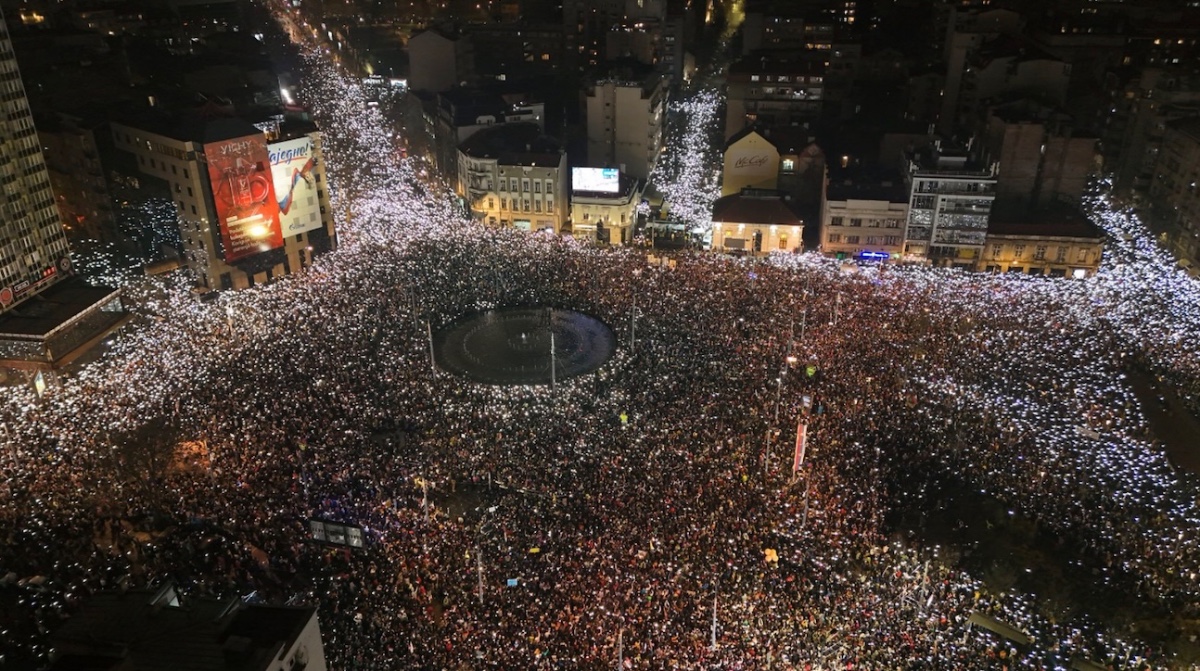
By March 2025, protests had been documented in at least 400 towns and villages across Serbia, culminating in several mass protests in major Serbian cities. On 15 March 2025, record number of people gathered in Belgrade,estimated 275,000 to 325,000 by the independent Archive of Public Assemblies, marking one of the largest demonstrations in the country’s history.
University blockades continued intensively for approximately six months, with support of Serbian academia, teachers and professors despite mounting pressure against the university and breaches of its autonomy. With increasing support of the citizens, students also organised a fourteen-day blockade of the public broadcaster RTS in April 2025, along with other forms of protests including long-distance marches, cycling journeys, including those to Brussels and Strasbourg, local gatherings and face-to-face encounters led by “Student in every village” expeditions, that extended the movement far beyond universities and major cities.
Students travelled across Serbia, meeting people in towns and villages rarely visited by national political leaders, as well as by conventional opposition, to hear their voices and note the issues they have been facing. These encounters built connections across generations, geographical and ethnic divisions and different social and political communities. The movement drew participation from diverse parts of the country, including Vojvodina and Sandžak, challenging the entrenched divisions that had long fragmented political opposition to the ruling party. Its achievement was therefore also social, as by cultivating trust and solidarity, the movement begun rebuilding a social fabric torn by years of polarisation, fear and political antagonism.
In political sociology, emotions are increasingly recognised as central to collective mobilisation. Grief and anger may trigger protest, but they rarely succeed to sustain it indefinitely. What made the Serbian Student movement distinctive was its ability to transform these emotions into lasting networks of solidarity, practical cooperation and collective political efficacy: the shared belief that citizens acting together could bring about change.
Perhaps the most consequential achievement of the student movement occurred even before a single ballot was cast – challenging the perception that Vučić’s autocratic political dominance was inevitable.
A new model of political organisation
The movement’s democratic, horizontal and leaderless organisational structure was fundamental to its resilience and success. The uniqueness of the Serbian student movement reflected not only from its path of emergence, but in the organizational structure it opted for – a decentralised system of plenums, university-level assemblies and inter-faculty coordination. Its democratic, horizontal and leaderless structure, which defied the presumption that people prefer conventional and predictable political actors, allowed them to debate the decisions collectively, distribute responsibilities, and to sustain mobilisation through networks rather than concentrated around a charismatic individual. Of course, this approach brought its own set of difficulties, including slow processes required for horizontal decision-making, demanding coordination and difficulties to maintain consensus across diverse groups, often perceived and “unstable”. Nevertheless, it was precisely these characteristics that proved remarkably resilient against familiar strategies of political pressure, personal targeting and attempts to discredit individual leaders.
Moreover, the Student movement demonstrated that innovative mechanisms of direct political participation can be developed and used alongside established representative institutions, particularly in the context of competitive authoritarian system. Against a backdrop of diminished public space for genuine debate and citizen participation, university plenums and local citizens’ assemblies created spaces in which people could engage directly with collective decisions and exercise political agency in practice. Yet, these participatory practices did not remain disconnected from or competing with the institutions of representative democracy, such as elections or parliament, but served as a corrective instrument to their instrumentalised, undermining and repurposing.
The students’ initial demands centred on core democratic principles: accountability for the Novi Sad tragedy, transparency and the effective functioning of public institutions. Their persistence that institutions have to be allowed to do their jobs responsibly placed the rule of law at the centre of public debate and their electoral campaign. When the façade government reshuffle failed to bring about any substantial change in the manner of state and institutional functioning, the movement called for extraordinary parliamentary elections by May 2025 and released their political program in June 2025. This marked a transition from demanding accountability through protest to seeking institutional political change through electoral campaign.
What followed was an innovative campaign skilfully adapted to Serbia’s uneven political environment, which successfully overcame all of the challenges that conventional opposition parties succumbed to. Capitalising on the immense mobilisation and infrastructure developed through protest, students combined traditional face-to-face mobilisation, door-to-door campaigning and local assemblies with extensive social media communication, thus ensuring that their messages reach cross-generational audiences beyond the conventional opposition electorate. The candidates of the Student list were chosen through its unique, horizontal decision-making process, engaging each of the plenums across Serbian universities to propose candidates for the 250 places in proportion to their size. Over several months, faculties proposed candidates in line with established criteria, questioned them at student plenums, deliberated and vetoing some while keeping their names secret. This deliberative collective decision-making process resulted in a democratically developed electoral list consisting mostly of academics, experts and public figures, registered as a citizens’ group.
Rather than relying on a small circle of prominent politicians, the Student List presented a broad range of candidates and spokespersons, with the Student List participating in seven of the first ten televised debates, each time represented by different person. In contrast to strongly centralised SNS campaign repeatedly represented by worn-out faces of familiar SNS officials, this approach reflected the movement’s emphasis on collective rather than personalised leadership.
It also demonstrated how street protests and democratic participation outside institutions can be reconnected with electoral democracy and participation through institutional means. For political systems faced with declining political trust, undermined space for participation, and overall challenges of autocratisation, this is one of key takeaways from these elections: participatory democratic practices can provide remedy for the crisis of representative politics and organisation foundations for its renewal.
From protest mobilisation to electoral victory
The student movement in Serbia achieved its first milestone by successfully translating the extraordinary mobilisation developed over nearly two years into political organisation and electoral victory. According to the preliminary estimates, the turnout reached approximately 69% or more than 4.4 million votes, compared to 58.77% in the previous 2023 parliamentary elections, and just under 49% in 2020. The historical comparison is striking. At the September 2000 Yugoslav presidential election, which preceded the overthrow of Slobodan Milošević, nearly five million voters participated, representing approximately 71.5% of the electorate which at the time included a significantly larger geographical area. Although the electoral frameworks are not directly comparable, the figures illustrate the exceptional scale of political engagement in October 2026.
Beyond the turnout itself, the translation of this extraordinary mobilisation into electoral monitoring was equally remarkable. More than 16.000 domestic and international observers were accredited, nearly three times the number accredited in 2023. Alongside independent observation organisation, such as CRTA, the Student List established an extensive network of polling-station representatives covering every polling station, seeking to ensure that electoral process is monitored and protected throughout the country. This was particularly important given the long record of disputed elections and serous concerns about electoral integrity. The preliminary assessment by the OSCE Office for Democratic Institutions and Human Rights (ODIHR) identified widespread inequalities in campaign conditions, misuse of state resources, intimidation and pressure on voters, and pronounced media bias favouring the ruling coalition amid a polarized environment. Observers also reported incidents of violence and procedural shortcomings, although most of the election day itself was assessed positively at the vast majority of polling stations monitored. CRTA yet again documented numerous irregularities but also highlighted the importance of organised citizen observation and well-prepared electoral representatives in limiting manipulations successfully.
Beyond electoral victory: Restoring democratic institutions
Serbia’s democratic transformation has only just begun. The electoral defeat of the SNS cannot automatically reverse more than a decade of institutional erosion. Political dominance became deeply entrenched through the weakening, politicisation and repurposing of institutions formally designed to constrain executive power and guarantee accountability. The electoral process is not finished yet, and until the constitution of the new parliamentary convocation and formation of the government, all leavers of power are still in the hands of the electoral losers prone to procedural manipulation and abuse of power.
My research on Serbia’s National Assembly illustrates how deeply these practices can become embedded in parliamentary dynamics, normalising the misuse of procedures. Across eight electoral cycles between 2007 and 2024, an average of approximately 46 days elapsed between parliamentary elections and the constitution of the new parliament, followed by another 35 days before a Speaker of the Parliament was elected to finalise the formation of the new convocation. In 2022, it took 120 days simply to constitute parliament, and in 2020 a total of 123 days passed between election day and the election of the Speaker, despite the overwhelming parliamentary dominance of the ruling coalition. While these extraordinary delays did not necessarily violate constitutional deadline, they were a part of the broader ruling strategy of the SNS regime which undermined the democratic processes through prolonged institutional dysfunction behind a façade of formal compliance with constitutional and legal procedures.
The immediate challenge ahead of the Student movement, therefore, is to complete the electoral process, establish the new parliamentary majority and ensure effective functioning of the legislature. The political transition is further complicated by the resignation of Aleksandar Vučić from the presidency in September 2026. Former parliamentary Speaker Ana Brnabić, currently still serving as acting president, still hasn’t scheduled the early presidential elections that must take place within the constitutionally prescribed timeframe, expiring at the end of December 2026. Until the new institutions are constituted, the outgoing political establishment retains considerable administrative and institutional influence, calling for particular vigilance over electoral procedures, parliamentary deadlines and the transfer of authority. But the deeper challenge goes far beyond the transition itself.
The new parliamentary majority will need to restore genuine legislative scrutiny, strengthen parliamentary committees, reinforce the independence of regulatory and oversight institutions, restore parliamentary deliberation and address systemic corruption through transparent and legally accountable processes. Institutional reform that awaits must avoid reproducing the concentration of power that the Student movement opposed. Accountability for past abuses is essential, but it must be pursued through independent investigations and due process to ensure no political retaliation. Moreover, the movements will also face the challenge of adapting its horizontal, participatory model to the demands of government.
A festival of citizen power
The morning after the elections offered a remarkable illustration of what the political transformation could mean in everyday life. In central Belgrade, nested between the Presidency and the National Assembly lies Pioneers’ Park. For more than a year, the whole park had been fenced off and occupied by a pro-government encampment known as Ćacilend. Fenced off with double line of greased fences and occupied by SNS “activists”, thugs and criminals in improvised tents that occupied children’s playground, covered by weed, withered grass and smelly porta-potties, this illegal settlement was a devastatingly true image of rotten, decayed regime it was defending. Its barriers and makeshift structures had transformed a public green space into a highly visible symbol of Serbia’s political divisions and state capture. For months I had wondered how long it would take to restore this park, just as I wondered how long it might take to restore the country’s decayed institutions.
Then, on the morning of 26 October, something extraordinary happened. Dozens of citizens of all ages gathered spontaneously to clean the newly reclaimed park, removing dismantled tents, collecting rubbish, cleaning and wiping the playground and benches, weeding pathways and planting flowers, in celebration of newly reclaimed freedom and public space. The electoral victory was being celebrated not only through the usual repertoire of speeches, flags and gatherings, but through an immediate act of collective responsibility.
Similar initiatives appeared across the country, reflecting the spirit of the Student movement that fuelled the unprecedented mobilisation, with citizens cleaning public spaces and removing hostile graffiti messages. There was something profoundly democratic in this simple act: people taking direct responsibility for the spaces they share, without waiting for instructions from political leaders. Of course, restoring a park is considerably easier than rebuilding an institutional system that has been systematically weakened by years of political capture. Yet, the symbolism matters, as imagining a simple reclaiming of this parked seemed almost impossible a couple of months ago.
The Student movement’s greatest achievement may be that they have revived the belief that democratic institutions and public spaces belong to citizens, and that citizens have both the right, power and responsibility to shape them. Serbia’s experience offers an important lesson at a time when representative democracy is struggling to respond to public dissatisfaction, on the one hand, and rising autocratisation, on the other. Democratic resilience cannot depend exclusively on periodically replacing those who govern, it also requires meaningful channels for citizens to participate, deliberate, organise and hold power accountable between elections. The challenge is to embed these participatory practices within representatives institutions, rather than allowing them to remain parallel forms of political action that disappear when mobilisation subsides.
The Serbian Student movement has demonstrated that people still posses the power to challenge entrenched political dominance, and the willingness to exercise it. It represents an avant-garde that needs to be studied, both in regard to the path of development shaped by misuse, instrumentalization and repurposing of democratic institutions and process, and in regard to its innovative structure and strategies developed in response. Its most important legacy will depend on whether that extraordinary collective power can now be transformed into innovative democratic mechanisms and embedded into an updated repertoire of democratic institutions, strong enough to withstand the next attempt to undermine them.
Photo source: @CRTArs