

By Ieva Hofmane (University of Latvia)
Latvia’s 2026 parliamentary election produced an unusually clear winner in a political system accustomed to fragmented outcomes. Prime Minister Andris Kulbergs’ United List (AS) won 35.29% of the vote and 41 of the Saeima’s 100 seats, the largest parliamentary delegation ever secured by a single political force in Latvia. Yet the result came with a striking counterpoint: voter participation fell to the lowest level ever recorded in a Latvian parliamentary election, with just 51.79% of eligible voters casting a ballot.
A crowded race ends in a highly concentrated result
There was little about the field at the start of the campaign to suggest such a one-sided ending. Fourteen lists and 1,428 candidates competed for the Saeima’s 100 seats, creating the kind of crowded contest more usually associated with another fragmented Latvian parliament.
The campaign unfolded against two overlapping sources of anxiety. Domestically, living costs, public spending and dissatisfaction with how the state was being run remained important. Externally, Latvia went to the polls as a NATO member bordering Russia and Belarus, with the war in Ukraine, Russian hybrid threats and the security of Latvian airspace unusually prominent in political debate. Kulbergs, who had become prime minister only on May 28, 2026 entered the election advocating continued support for Ukraine, higher defense preparedness, less bureaucracy and a more forceful style of government.
That short period in office appears to have mattered. AS had already been gaining support at a remarkable pace in the months before the election: Politico’s Poll of Polls showed it climbing from around 10% in the spring to 22% by mid-September, making it the clear frontrunner. Yet even this steep rise gave little indication of the scale of what was to come. An election-day exit poll put AS close to 35%, suggesting that its support had surged well beyond what pre-election polling had anticipated. Kulbergs interpreted the result as evidence that voters wanted both change and a more direct style of political communication.
What followed was not simply an election victory, but an electoral landslide.
Kulbergs redraws Latvia’s political map
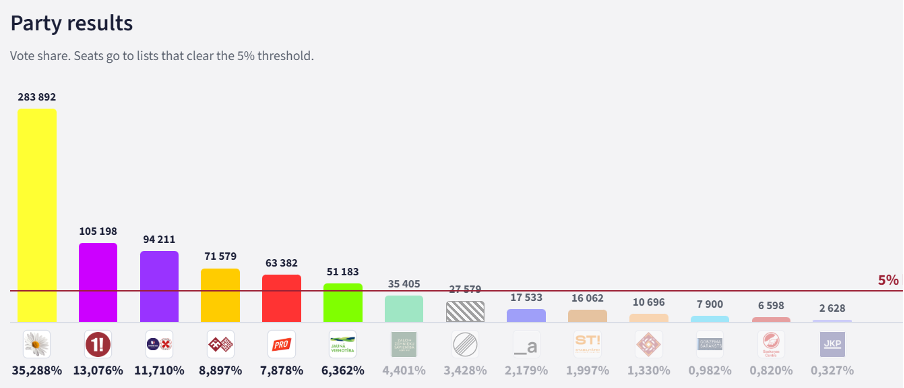
United List won 35.29% of the vote and 41 seats. Latvia First finished second with 13.08% and 17 seats, followed by Sovereign Power/Young Latvians with 11.71% and 15. The National Alliance and the Progressives won 10 seats each, and New Unity seven. Six lists crossed the 5% threshold.
Figure 1. Party results in Latvia’s 2026 parliamentary election.
Source: Central Election Commission of Latvia (CVK).
The magnitude of the AS result is historically exceptional. No single political force has previously won as many seats in a Latvian parliamentary election. The post-restoration record had belonged to Latvijas ceļš, which secured 36 seats in 1993; before that, the Latvian Social Democratic Workers’ Party had won 32 in 1925. AS’s 41 seats comfortably surpass both benchmarks.
Even more striking is the geography of the victory. In 2022, New Unity had been the leading party in 21 of the then 43 municipalities, while AS had topped the poll only in Liepāja and South Kurzeme. Four years later, the map had almost completely changed: AS came first in 36 of Latvia’s 42 municipalities, failing to win only six, all in Latgale, where Latvia First came first.
This is more than the normal movement of votes between coalition partners. It represents a dramatic concentration around Kulbergs and AS at precisely the moment when several established parties were collapsing. The Greens and Farmers Union (ZZS), historically one of Latvia’s most durable political organizations, received 4.40% and failed to enter the Saeima for the first time in its history. Stabilitātei! fell to 1.997%, while New Unity, the dominant force in the previous election, survived with only 6.36% and seven seats.
The message of the map is therefore unusually clear: Latvia did not merely rotate the parties at the top. It reorganized political power around one dominant electoral pole.
The Russian-speaking vote moves again
The other major story is taking place below the headline victory. Sovereign Power/New Latvians’ (SV/AJ) third-place finish with 11.71% and 15 seats is one of the election’s most significant breakthroughs, particularly because it occurred alongside a strong performance by the far-right Latvia First (LPV) party, led by veteran politician Ainārs Šlesers, who opposes restrictive tariffs on Russia. Both competed heavily for voters who in previous elections had gravitated toward Russian-speaking parties such as Harmony and, more recently, Stabilitātei!.
For many years, Latvia’s Russian-speaking voters could be discussed in terms of a relatively consolidated political bloc centered on Harmony and its predecessors. That is no longer an adequate description. Before this election, analysis by the Centre for Eastern Studies characterized the Russian-speaking electorate as increasingly fragmented, with LPV and SV/AJ emerging as the two strongest competitors for it. Their electorates were not identical: LPV tended to appeal to more economically oriented and comparatively moderate voters, while SV/AJ under Jūlija Stepaņenko attracted, among others, older and economically disadvantaged voters more favorable to improving relations with Latvia’s eastern neighbors.
Latvian political scientist Juris Rozenvalds had also argued before the election that SV/AJ’s appeal should not be reduced entirely to ethnicity. He pointed to its leadership, skillful social-media campaigning and a program capable of attracting some Latvian-speaking voters as well. Earlier municipal results had nevertheless shown especially strong SV/AJ performances in places where politicians associated with the former Latvian Russian Union ran on its lists, indicating that ethnic-political networks continued to matter.
The result thus looks less like the rebirth of one unified “Russian party” than a reorganization of the Russian-speaking political market. Reuters reported that LPV actively appealed to ethnic Russian voters, while SV/AJ drew support among Russian speakers critical of policies including support for Ukraine and Latvia’s language requirements. At the same time, attitudes within the Russian-speaking community remain divided, including over Russia’s invasion of Ukraine.
The geography reinforces that interpretation. In the six Latgale municipalities where AS did not finish first, LPV did. The voters have not disappeared; the organizations competing for their votes have changed.
A landslide in the quietest election
There is, however, another number that should temper any reading of an overwhelming national mandate: 51.79%.
Only 806,641 of Latvia’s 1,557,615 eligible voters cast a ballot, making the 2026 contest the lowest-turnout parliamentary election in Latvian history. Turnout in 2022 was about 59.4%, meaning participation fell by roughly 7.6 percentage points in four years.
National turnout also conceals a substantial territorial divide. Vidzeme reached 59.05%, Kurzeme 55.26%, and Zemgale 54.48%. In Latgale, the eastern region adjoining Russia and Belarus, turnout was only 47.17%. The Riga electoral district was lower still at 46.43%. Riga’s electoral district is structurally different because it also encompasses the diaspora electorate, so comparisons with the other four districts should be made cautiously.
This territorial gap deserves as much attention as AS’s victory. Low participation in Latvia’s eastern borderlands overlaps with regions where linguistic identity, economic dissatisfaction, geopolitical orientation, and mistrust of national institutions have long interacted. It would be too simple to interpret abstention there as a single political statement, but it does mean that the next government faces a representation challenge alongside its impressive parliamentary majority: some of the parts of Latvia most exposed to geopolitical and social tensions were also among those least engaged in choosing the national parliament. The election therefore produced both a powerful winner and an unusually large group of citizens who chose no winner at all.
Collapse, survival and missed opportunities
Behind the AS landslide lies an equally striking story of collapse and missed opportunities among Latvia’s established parties. The biggest institutional casualty was the Greens and Farmers Union, which received 4.40% and fell below the 5% threshold, leaving it outside the Saeima for the first time in its history. A late campaign drunk-driving scandal involving one of its ministers hardly helped, but its difficulties ran deeper: some of the electorate that had previously sustained ZZS appears to have found a more attractive home in Kulbergs’ United List.
New Unity suffered an even more dramatic reversal electorally. The largest party in 2022, when it received 19.19% of the vote and won 26 seats, was reduced to 6.36% and seven MPs. The result reflects the extent of voter disappointment with a party that had dominated government for much of the previous parliamentary term, culminating in the collapse of Evika Siliņa’s coalition earlier this year.
Yet the Progressives failed to fully capitalize on New Unity’s decline. Their vote share rose from 6.23% in 2022 to 7.88%, but they remained on 10 seats. Rather than losing a seat, as the earlier count suggested, they ultimately held their parliamentary representation—but still missed an obvious opportunity to turn New Unity’s collapse into a much larger liberal parliamentary bloc.
The National Alliance also emerged weakened, falling from 13 seats to 10 despite a vote share relatively close to its previous result. Its nationalist base remained comparatively resilient, but AS’s dominance still squeezed the party’s representation.
The result was therefore more than an AS victory: it was a substantial redistribution of political power, leaving Kulbergs dominant while several parties that had shaped the previous parliament emerged diminished – or disappeared altogether.
The most likely government: a conservative turn – with or without New Unity
Coalition arithmetic is considerably easier than it looked before election day. United List’s 41 seats place Kulbergs in an extraordinarily strong bargaining position. Together with the National Alliance’s 10, AS would command 51 seats – just enough for a two-party majority government.
An AS–NA government therefore remains the most straightforward ideological outcome. The two parties have already governed together under Kulbergs, and a two-party cabinet would give the prime minister considerable freedom to pursue the reform agenda on which he campaigned. Kulbergs has framed the coming negotiations largely in managerial terms, emphasizing reforms, reductions in waste, fiscal responsibility, defense, and cutting bureaucracy.
The two-party option, however, comes with a thin margin for error. A 51-seat majority could quickly become vulnerable if disagreements emerge within AS’s large and heterogeneous parliamentary group. For that reason, Kulbergs may choose to bring New Unity’s seven MPs into the coalition as political insurance. AS–NA–JV would hold 58 seats, providing a substantially more comfortable parliamentary majority.
The choice between the two formulas would nevertheless matter politically. AS–NA alone would mark a clearer turn toward conservative values and consolidate the election around Kulbergs’ leadership. Adding New Unity would broaden the coalition toward the political center and provide greater parliamentary security at the cost of a somewhat more complicated governing arrangement. Other combinations are mathematically possible, but the central question is increasingly whether Kulbergs wants to govern with the smallest ideologically coherent majority or add New Unity for safety.
Either way, the result does not point toward a reversal of Latvia’s pro-European or pro-Ukrainian geopolitical orientation. What it does suggest is a significant shift in the balance of power within that camp: away from the fragmented coalitions of recent years and toward a government in which Kulbergs and AS are unmistakably dominant.
A mandate for command
The most interesting question, however, may be what Latvians thought they were voting for.
One way to read the result is as a vote for clearer political responsibility and more decisive leadership. Kulbergs had been prime minister for only about four months. Yet that was enough time to construct an image of someone prepared to take matters into his own hands and get things done. Before the election, AS and Kulbergs had already created the impression that, after a period of stagnation, things had begun moving again.
This helps explain why the election feels even more personalized than before. AS was already represented in parliament, but its transformation from a modest force that won only Liepāja and South Kurzeme in 2022 into the winner of 36 municipalities four years later coincided with Kulbergs’ brief premiership. The historic 41-seat result therefore looks, at least partly, like a mandate attached to the prime minister himself.
But that is also where the result becomes potentially more concerning.
Kulbergs’ preference for decisive executive action had already collided with norms of professional public administration during the summer. In June he pushed for changes that would allow the prime minister, in specified circumstances, to select the director of the State Chancellery – Latvia’s highest-ranking civil servant – without an open competition. Kulbergs criticized the existing requirement as bureaucratic and argued that lengthy recruitment procedures could paralyze government. Parliament adopted the amendments under urgency on June 18. Their supporters stressed that open competition remained the general rule.
The episode nevertheless generated an institutional warning. Transparency organization Delna argued that dispensing with open competition could weaken public confidence and increase the risk that the senior civil service would be seen as serving political rather than public interests. Critics in parliament likewise stressed that the State Chancellery director is a professional, not a political, position. President Edgars Rinkēvičs subsequently promulgated the amendments at the end of June.
None of this means that a Kulbergs-led government necessarily entails democratic backsliding. But the qualities that attracted voters – decisiveness, personal responsibility, and impatience with institutional obstacles – will also test Latvia’s institutional safeguards. After October 3, the question is no longer whether Kulbergs has the authority to govern; voters have given him more of it than any Latvian parliamentary leader in generations. The question is how he will use it.
Photo source: https://www.aljazeera.com/news/2026/10/3/latvians-head-to-polls-with-security-and-cost-of-living-in-focus