

By Jonathan Polk (Lund University)
There are eight parliamentary parties in Sweden and in the 2026 electoral campaign they cluster into two blocs of varying cohesiveness. On the right, there are the three parties of government, the Moderates (M), Christian Democrats (KD), and Liberals (L), with support from the anti-immigration Sweden Democrats (SD). The red-green opposition consists of the Social Democrats (S), the Left Party (V), the Greens (MP), and the Centre Party (C). Although polling throughout the spring and summer of 2026 showed a large lead for the red-green opposition, the gap rapidly closed as the election drew nearer and it did indeed end up becoming a tight race. The final calculation of votes from the 13 September election was not completed until 17 September, when it became clear that the red-green opposition obtained 176 of the Swedish Riksdag’s 349 seats compared to the right bloc’s 173, giving the opposition parties a slim majority. Just over 50,000 votes separate the blocs, a sum smaller than the number of blank ballots cast in the election and the number of individuals currently waiting for decisions on citizenship applications. The closeness of the election mirrors the results of the 2022 parliamentary election and reflects the continued organisation of a multiparty system around two political blocs, albeit with significant tensions within each bloc.
There were ample opportunities for tactical voting within both the red and blue blocs. For the governing parties and SD, the challenge was the precarious electoral position of L. Earlier this year, the party polled as low as 1%, well below the 4% threshold for representation in Sweden’s parliament. Without representation from L, it would be nearly impossible to build a right-wing majority based on the projected electoral support of these parties throughout the year. In a substantial turnabout, L ended up clearing the electoral threshold cleanly, with 5.3% of the vote, which even represented a 0.7 percentage-point increase in its vote share in comparison to 2022. In fact, all three parties of government saw their vote share increase, with the Moderates at 19.8% (a 0.7 percentage-point increase) and the Christian Democrats at 6.2% (a 0.8 percentage-point increase), based on preliminary calculations. It was the electoral decline of the Sweden Democrats, from 20.5% to 17.5%, that made the difference in 2026 (a point to which I return below).
On the left, the tactical considerations revolved around post-election government formation scenarios within the opposition. V, a long-time support party of former left-wing minority governments, stated quite clearly throughout the election campaign that it would not support a government in which it did not receive ministerial positions. C, however, was equally adamant that it would not support a government that formally included V. If we simplify Swedish politics to the standard broader economic left-right and socio-cultural dimensions prominent across western European party systems, C and V do not dramatically differ from one another on the socio-cultural dimension, with both clearly on the GAL side of the GAL-TAN divide. But the differences between these parties on the economic dimension of politics are vast, with V the most economically left-leaning party in Sweden and C as far or farther to the economic right than all of the parties of the right bloc.
Voters in the broader left field of Swedish politics thus faced clear incentives to make a tactical choice between V or C in an attempt to pull any red-green coalition in its preferred ideological direction, with economically left-leaning voters looking to V and those looking for more centrist economic positioning from any red-green government potentially expressing this through a vote for C. The 2.3 percentage-point decline in S’s vote share to 28.0%, its lowest result in a Riksdag election in the modern era, should be considered through this lens of tactical voting within the left bloc, which may also help explain the strong election results of V (8.4%), MP (6.1%), and to a lesser extent C (7%) relative to their vote share in 2022.
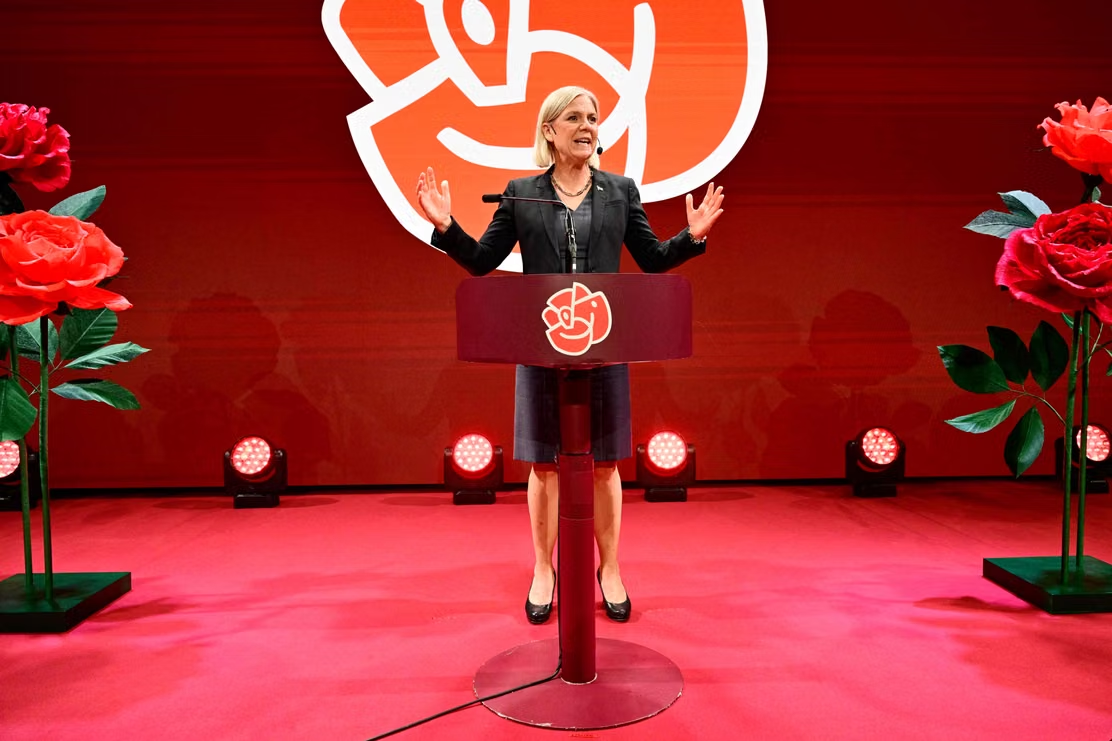
Cumulatively, the evidence of tactical voting in the Swedish parliamentary election of 2026 suggests considerable sophistication in the voting behaviour of the Swedish electorate in the form of both directional and coalition-oriented voting, and presents a challenging post-election bargaining environment for Magdalena Andersson, party leader of the Social Democrats.
In 2026, all parties gained votes except for S and SD, the two largest parties in the 2022 election. This provides further evidence of the party-system fragmentation occurring across Europe, with the difference that prior to this election SD, an anti-immigration challenger party, had increased its vote share in every parliamentary election, culminating in it becoming the largest party within the parliamentary base supporting the Kristersson government after 2022. In one way the party’s decrease of over 3% in 2026 compared to 2022 is a major change in Swedish politics and a serious electoral setback for SD, particularly in comparison with the (modest) growth in electoral support for the other members of the blue bloc. But in another way SD has been quite successful at shifting the entire party system in its preferred direction on its central issues of immigration and law and order politics. Where the party once had pariah status, even within the parties of the right, its positions and politics are now thoroughly integrated among the right bloc of Swedish parties, with SD expected to obtain ministerial positions had a right-leaning majority emerged after the 2026 election.
The extent of the changes related to SD’s electoral rise was also clear in the 2026 electoral campaign of S. Although perhaps the clearest and most consistent message from Andersson and the Social Democrats was against the possibility of SD receiving as many as 12 ministerial positions in a new right-wing government, S was almost equally loud about its support for “tight” migration policy, being tougher on crime, and the need for more police on the streets. Again, if we think about the GAL-TAN socio-cultural dimension, S’s positioning throughout the campaign was considerably more TAN, particularly on migration, than the other parties of the red-green opposition. This may have been an attempt to follow the strategy of its Danish Social Democrat neighbours by attempting to peel away SD voters that are economically left-leaning but restrictive in their immigration preferences. This may also help explain the decline in S’s electoral support and the increase in vote share for other members of the red-green opposition. S may have calculated that managing the broader left field of Swedish politics meant losing some of its socio-culturally progressive voters to other parties of the green-left, but that these parties would still ultimately be folded into a left-leaning red-green government with Social Democratic leadership.
Further evidence in support of this potential S strategy came in a video address published by Andersson on 17 September, after the election results became clearer. In the speech, she spoke of a new era for those who have not felt welcome in the country and of the need for a reasonable (rimlig), rather than tight (stram), migration policy, the latter of which was used throughout the electoral campaign. It illustrates that Andersson and S have entered a different, post-electoral phase of politics, in which the party is now focused on the challenging process of building a government among parties that share liberal socio-cultural positions but differ dramatically in their economic orientation.
As an immigrant in Sweden, it is difficult not to view Andersson’s shift in language with some cynicism. As a student of electoral behaviour and party competition, however, I can understand the strategic incentives behind it, even if the potential for political backlash appears considerable. As a political scientist that is particularly interested in estimating party positions, I think it is a nice illustration of why we often need comprehensive measures of party positioning that take into account both the pre and post-electoral periods.
Photo source: https://www.lemonde.fr/en/international/article/2026/09/17/sweden-s-left-wing-wins-slim-majority-in-general-election_6757628_4.html